

ESG in India: Complete Guide
If you work in a factory, a compliance department, an investor relations team, or an EHS role anywhere in India today, you have almost certainly heard the word “ESG” thrown around in board meetings, audit reports, and vendor questionnaires. Yet ask five people in the same organisation to define it, and you will likely get five different answers. Some will call it “the new CSR.” Others will call it “a rating that investors look at.” A few will confuse it entirely with ISO certification or carbon accounting.
This guide exists to clear that confusion once and for all — specifically for the Indian context, where the regulatory landscape around ESG has moved faster in the last three years than in the previous decade combined. We will walk through what ESG actually means, how it is regulated in India through instruments like SEBI’s Business Responsibility and Sustainability Reporting (BRSR), how it differs from CSR and sustainability, how EHS professionals fit into the picture, and what practical steps a manufacturing unit, a listed company, or a consultant needs to take to get ESG right — not just on paper, but in practice.
1. What is ESG? A Working Definition
ESG stands for Environmental, Social, and Governance — three broad categories of non-financial factors that investors, regulators, customers, and employees now use to evaluate how sustainably and responsibly a company is run.
Put simply: ESG asks three questions about any organisation.
- Environmental: How does this company treat the planet? Its emissions, energy use, water consumption, waste generation, and impact on biodiversity.
- Social: How does this company treat people? Its employees, contract workers, supply chain, customers, and the communities around its operations.
- Governance: How is this company actually run? Its board structure, executive pay, anti-corruption controls, shareholder rights, and internal ethics.
ESG is not a certification you can buy, and it is not a single number you either pass or fail. It is a lens — a way of evaluating risk and performance that sits alongside (not instead of) traditional financial analysis. A company can be highly profitable on its income statement and still carry significant ESG risk — think of a textile exporter with excellent margins but a wastewater discharge violation waiting to happen, or a listed manufacturer with strong revenue growth but a board with no independent oversight of related-party transactions.
“ESG is what risk management looks like when you stop pretending environmental and social factors are externalities.” — a framing increasingly used by Indian institutional investors when explaining ESG integration to portfolio companies.
2. A Short History: How ESG Became Mainstream
The term “ESG” was formally coined in a 2004 report titled Who Cares Wins, a joint initiative between the United Nations Global Compact and major financial institutions. But the underlying ideas are much older — they trace back to socially responsible investing (SRI) movements of the 1960s and 70s, which screened out investments in tobacco, weapons, and apartheid-linked companies.
What changed after 2004 was the shift from values-based exclusion (avoiding “bad” companies) to risk-based integration (treating environmental and social factors as financially material risks, regardless of one’s personal ethics). This reframing is what made ESG palatable to mainstream finance, not just ethical investors.
In India, the journey has its own timeline, and it is worth knowing because it explains why Indian regulation today looks the way it does:
3. The Three Pillars of ESG Explained
Before we go deep into each pillar, it helps to see them side by side. Here is a snapshot comparison that most consultants use when first explaining ESG to a factory owner or a board member:
| Pillar | Core Question | Typical Metrics | Typical Indian Regulation |
|---|---|---|---|
| Environmental | What is the impact on natural resources and climate? | GHG emissions (Scope 1, 2, 3), energy intensity, water withdrawal, waste generated/recycled, biodiversity impact | Environment (Protection) Act 1986, Air/Water Acts, EPR rules (plastic, battery, e-waste), Environmental Clearance |
| Social | What is the impact on people? | Employee safety (LTIFR, TRIR), diversity ratios, wages, training hours, supply chain labour practices, community grievance redressal | Occupational Safety, Health and Working Conditions Code 2020; Factories Act 1948; POSH Act 2013; Minimum Wages |
| Governance | How is the company controlled and held accountable? | Board independence, audit committee structure, executive pay ratio, anti-bribery policy, whistleblower mechanism, related-party transaction disclosure | Companies Act 2013, SEBI LODR Regulations, Prevention of Corruption Act |
Notice something important here: every single ESG metric maps back to a real, pre-existing Indian law. ESG did not invent new obligations out of thin air — it packaged existing environmental, labour, and corporate governance compliance into a single reporting and investment lens. This is a critical insight for EHS professionals: you have probably been doing “E” and parts of “S” for years without calling it ESG.
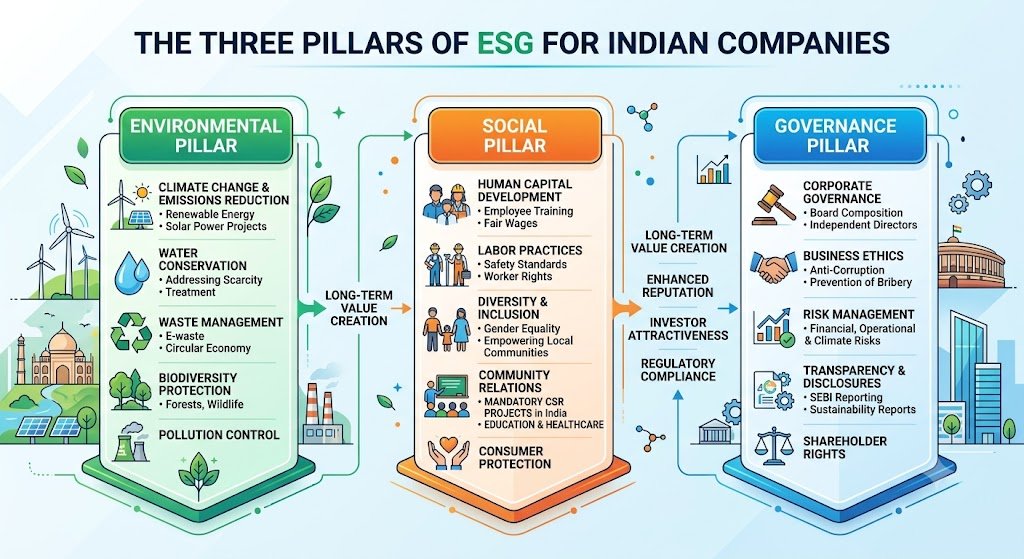
4. The Environmental Pillar (E)
The Environmental pillar covers a company’s direct and indirect impact on natural systems. For Indian manufacturing and industrial companies, this is usually the most technically demanding pillar because it requires actual measurement — not just policy statements.
4.1 Greenhouse Gas (GHG) Emissions
GHG emissions are categorised into three “scopes” under the internationally recognised GHG Protocol:
- Scope 1: Direct emissions from sources a company owns or controls — furnace fuel combustion, company vehicles, fugitive refrigerant leaks.
- Scope 2: Indirect emissions from purchased electricity, steam, heating, or cooling.
- Scope 3: All other indirect emissions across the value chain — purchased raw materials, employee commuting, business travel, use of sold products, and end-of-life treatment of products.
For most Indian manufacturers, Scope 3 is by far the largest and hardest category to measure — often 70-90% of total footprint — because it requires data from suppliers who may have no ESG capability of their own. This is exactly where large Indian companies are now pushing ESG questionnaires down their supply chains, which is why even a small ancillary unit supplying to a large auto OEM may suddenly be asked for energy and emissions data it has never tracked before.
4.2 Energy Management
Energy intensity (energy consumed per unit of output) is one of the most-watched Environmental metrics in Indian manufacturing, closely tied to the Perform, Achieve and Trade (PAT) Scheme run by the Bureau of Energy Efficiency (BEE) under the Ministry of Power, which sets sector-specific energy-reduction targets for large energy-consuming units (“Designated Consumers”) across sectors like cement, steel, textiles, and chemicals.
4.3 Water Management
Water stress is an acute issue for Indian industry, particularly in water-scarce states like Rajasthan, Gujarat, and parts of Tamil Nadu. ESG water metrics typically track:
- Total water withdrawal by source (surface, ground, municipal, third-party)
- Water recycled and reused as a percentage of total consumption
- Water discharge quality (relevant to Water (Prevention and Control of Pollution) Act, 1974 compliance and CPCB/SPCB consent conditions)
4.4 Waste Management and Circularity
This is where ESG reporting increasingly overlaps directly with EHS compliance obligations that many readers of this site already manage day to day — the Hazardous and Other Wastes (Management and Transboundary Movement) Rules, 2016, the Plastic Waste Management Rules, 2016 (as amended), the E-Waste (Management) Rules, 2022, and the Battery Waste Management Rules, 2022 (covered in detail elsewhere on this site) all generate the underlying data that ends up in a company’s ESG waste disclosures.
A well-run EHS department that already tracks hazardous waste manifests, EPR obligations, and recycling percentages is, in effect, already producing 60-70% of the raw data an ESG report needs on the “E” side. The gap is usually not data collection — it’s aggregation, assurance, and disclosure in the specific format regulators and rating agencies expect.
4.5 Biodiversity and Land Use
Less discussed but increasingly material for mining, cement, and infrastructure companies operating near forests, wetlands, or protected areas. Environmental Clearance conditions under the EIA Notification, 2006 already require biodiversity management plans for many project categories — ESG reporting simply formalises the disclosure of how these plans are performing.
5. The Social Pillar (S)
The Social pillar is often underestimated by industrial companies that assume ESG is “mostly environmental.” In reality, for labour-intensive Indian sectors like textiles, construction, and manufacturing, the Social pillar carries just as much investor and regulatory weight.
5.1 Occupational Health and Safety
This is the most direct overlap with traditional EHS work. Key metrics include:
| Metric | What It Measures |
|---|---|
| LTIFR (Lost Time Injury Frequency Rate) | Number of lost-time injuries per million hours worked |
| TRIR (Total Recordable Incident Rate) | All recordable injuries per 200,000 hours worked |
| Fatality rate | Number of work-related fatalities, including contractor workers |
| Near-miss reporting rate | Leading indicator of safety culture maturity |
| Safety training hours per employee | Investment in building safety competency |
India’s consolidation of 13 central labour laws into the Occupational Safety, Health and Working Conditions (OSH) Code, 2020 is the single most important piece of legislation underpinning this part of the Social pillar, though its rules are still being operationalised state by state as of this writing.
5.2 Labour Practices and Human Rights
This includes fair wages, freedom of association, prohibition of forced and child labour, and — critically for Indian companies with global supply chain exposure — contract labour conditions. Many Indian factories rely heavily on contract and migrant labour, and ESG-conscious buyers (particularly European and North American brands sourcing from India) now audit these conditions rigorously, often more strictly than domestic law requires.
5.3 Diversity, Equity and Inclusion (DEI)
Gender diversity on the shop floor and in leadership, representation of persons with disabilities, and pay equity are increasingly tracked. SEBI’s BRSR format specifically requires disclosure of the gender pay gap and the percentage of women in the workforce, in management, and on the board.
5.4 Community and Stakeholder Engagement
This is where CSR spending under Section 135 of the Companies Act most directly feeds ESG disclosure — but ESG asks for more than just the CSR spend amount. It asks about grievance redressal mechanisms for communities affected by operations (relevant for mining, power, and infrastructure projects), and about free, prior, and informed consent processes for land acquisition.
6. The Governance Pillar (G)
Governance is the pillar most removed from day-to-day EHS work, but it is often the one investors weigh most heavily — because poor governance is frequently the root cause behind Environmental and Social failures. A board with no independent oversight is far more likely to ignore an emerging pollution liability or a safety data cover-up.
6.1 Board Composition and Independence
Under SEBI’s Listing Obligations and Disclosure Requirements (LODR) Regulations, listed companies must maintain a minimum proportion of independent directors, and for the top 1,000 listed entities by market capitalisation, the roles of Chairperson and Managing Director/CEO must generally be separated (with some exceptions on a “comply or explain” basis).
6.2 Executive Compensation
ESG-conscious investors scrutinise the ratio between CEO pay and median employee pay, and whether executive compensation is linked to long-term ESG performance targets rather than short-term financial metrics alone.
6.3 Business Ethics and Anti-Corruption
Whistleblower policies (vigil mechanisms, mandatory under Companies Act Section 177 for certain classes of companies), anti-bribery and anti-corruption policies, and codes of conduct fall here. The Prevention of Corruption Act, 1988 (as amended in 2018) is the underlying statute.
6.4 Risk Management and Internal Controls
This includes how a company identifies, monitors, and discloses material risks — including climate risk, which is increasingly treated as a governance disclosure item (does the board have oversight of climate risk?) as much as an environmental one.
6.5 Shareholder Rights
Equal treatment of minority shareholders, transparency in related-party transactions, and voting rights structures.
7. ESG vs CSR vs Sustainability: What’s the Difference?
This is, without exaggeration, the single most common point of confusion in Indian boardrooms. Let’s settle it clearly.
| Aspect | CSR | Sustainability | ESG | |
|---|---|---|---|---|
| Primary orientation | Philanthropy and community welfare spending | Long-term environmental and social stewardship as a business philosophy | Investor-grade, measurable risk and performance disclosure | |
| Legal basis in India | Section 135, Companies Act 2013 (mandatory 2% net profit spend for qualifying companies) | Largely voluntary; guided by frameworks like NGRBC | SEBI BRSR (mandatory for top 1,000 listed companies); increasingly assured | |
| Who consumes the output | Communities, regulators (compliance check) | Broad stakeholders, brand reputation | Investors, lenders, rating agencies, institutional shareholders | |
| Measurement rigour | Spend amount tracked; impact measurement often weak | Varies widely; often narrative-based | Quantitative, standardised, increasingly subject to third-party assurance | |
| Typical owner in a company | CSR/Corporate Affairs team | Sustainability or EHS department | CFO’s office, Company Secretary, or a dedicated ESG/Sustainability head reporting to the board |
The simplest way to remember it: CSR is what you spend, Sustainability is what you believe, and ESG is what you disclose and get scored on. A company can run excellent CSR programmes and still score poorly on ESG if its core operations carry unmanaged environmental or governance risk — the CSR spend does not offset a poor safety record or weak board independence.
8. ESG Regulations in India: The Complete Picture
India does not have a single “ESG law.” Instead, ESG obligations are assembled from multiple regulatory sources that, together, form the compliance backbone. Here is the full picture:
| Regulation / Body | What It Requires | Who It Applies To |
|---|---|---|
| SEBI BRSR | Structured ESG disclosure across 9 principles of the NGRBC | Top 1,000 listed companies by market cap |
| SEBI BRSR Core + Assurance | A smaller set of ESG KPIs requiring reasonable assurance by an independent assurance provider | Top 250 listed companies by market cap (phased) |
| Companies Act 2013, Section 135 | Mandatory CSR spend of 2% of average net profit of preceding 3 years | Companies meeting net worth/turnover/profit thresholds |
| Environment (Protection) Act, 1986 and rules made under it | Pollution control, hazardous substance management, EPR schemes | All industries as per category and scale |
| OSH Code, 2020 | Consolidated occupational safety and working condition standards | Establishments as per applicability thresholds |
| RBI Framework for acceptance of green deposits / climate risk disclosures | Climate-related financial risk disclosure for regulated entities | Scheduled commercial banks, select NBFCs |
| IFSCA ESG guidelines | ESG-labelled debt securities and fund disclosure norms | Entities operating in India’s International Financial Services Centre (GIFT City) |
A crucial nuance for readers: most Indian companies are not directly bound by BRSR — only the top 1,000 listed companies are. But mid-sized and small manufacturers are increasingly pulled into ESG compliance indirectly, as suppliers to these large companies pass ESG data requirements down the supply chain contractually, even without a direct legal mandate.
9. BRSR Deep Dive: What Every Listed Company Must Report
The Business Responsibility and Sustainability Report is structured around the National Guidelines on Responsible Business Conduct (NGRBC), which lay out nine principles. Every listed company within scope must report against all nine:
- Businesses should conduct themselves with integrity and in a manner that is ethical, transparent, and accountable.
- Businesses should provide goods and services in a manner that is sustainable and safe.
- Businesses should respect and promote the well-being of all employees, including those in the value chain.
- Businesses should respect the interests of, and be responsive to, all stakeholders.
- Businesses should respect and promote human rights.
- Businesses should respect and make efforts to protect and restore the environment.
- Businesses, when engaging in influencing public and regulatory policy, should do so responsibly.
- Businesses should promote inclusive growth and equitable development.
- Businesses should engage with and provide value to their consumers in a responsible manner.
Each principle is broken into Essential Indicators (mandatory, quantitative) and Leadership Indicators (aspirational, encouraged but not compulsory). This two-tier structure is deliberate — it lets SEBI raise the bar over time by gradually converting Leadership Indicators into Essential ones, without a full regulatory overhaul each time.
9.1 BRSR Core
Introduced in 2023, BRSR Core is a focused subset of the full BRSR — nine Key Performance Indicator categories (GHG footprint, water footprint, energy footprint, waste management, employee well-being, gender diversity, and others) that are being phased in for reasonable assurance, starting with the top 150 listed companies by market cap and expanding to the top 1,000 over subsequent years. This assurance requirement is the single biggest shift underway in Indian ESG regulation — it converts ESG disclosure from a self-reported narrative into something closer to a financial audit.
9.2 Value Chain Reporting
From FY 2024-25, top listed companies are expected to disclose ESG data not just for their own operations but on a comply-or-explain basis for their value chain — meaning large companies increasingly need ESG data from their vendors, contractors, and suppliers, which is precisely why smaller manufacturing units across India are suddenly fielding ESG questionnaires from customers who never asked before.
10. Global ESG Frameworks and Standards
While BRSR is India’s mandatory framework, several global voluntary frameworks continue to shape how Indian companies — especially those with export markets or foreign investors — structure their broader sustainability disclosures:
| Framework | Focus | Relevance to Indian Companies |
|---|---|---|
| GRI (Global Reporting Initiative) Standards | Broad stakeholder-oriented sustainability reporting | Widely used as the narrative backbone for voluntary sustainability reports, often alongside BRSR |
| SASB (Sustainability Accounting Standards Board) | Industry-specific, financially material ESG metrics | Now part of the IFRS Foundation’s ISSB; used by Indian companies with US investor bases |
| TCFD (Task Force on Climate-related Financial Disclosures) | Climate risk governance, strategy, and scenario analysis | Increasingly referenced by RBI’s climate risk disclosure framework for banks |
| ISSB (International Sustainability Standards Board) IFRS S1/S2 | Global baseline for sustainability and climate disclosure, converging GRI/SASB/TCFD approaches | Watched closely as a likely future convergence point for BRSR |
| CDP (formerly Carbon Disclosure Project) | Climate, water, and forest-related corporate disclosure | Used by many large Indian exporters to satisfy global buyer requirements |
A practical note for Indian companies: you do not need to pick just one. Most large Indian companies today publish a single Sustainability/Integrated Report that maps its content simultaneously to GRI, BRSR, and often SASB or TCFD, using cross-reference indexes so that different stakeholder audiences (a domestic regulator vs a foreign institutional investor) can each find what they need.
11. ESG Rating Agencies: How Companies Get Scored
ESG ratings are third-party assessments — not government certifications — that score companies on their ESG performance, usually on a letter or numeric scale. Major agencies active in the Indian market include:
- MSCI ESG Ratings — widely used by global institutional investors; rates companies AAA to CCC.
- Sustainalytics (a Morningstar company) — provides an ESG Risk Rating measuring unmanaged ESG risk.
- CRISIL ESG Ratings — an Indian rating agency (part of S&P Global) with ratings calibrated more closely to Indian regulatory context.
- ICRA ESG Ratings and CARE ESG Ratings — other domestic agencies offering India-specific ESG assessments.
An important caveat every reader should internalise: different ESG rating agencies frequently give the same company wildly different scores, because each uses its own proprietary methodology, weighting, and data sources. This is one of the most-cited criticisms of the ESG ratings industry globally (academic studies have found correlation between major rating agencies’ scores for the same company as low as 0.3 on a scale where 1.0 would mean perfect agreement). Companies should not treat a single rating as gospel — they should focus on the underlying data quality and disclosure completeness, which drives performance across most methodologies.
12. Materiality Assessment: The Starting Point of Every ESG Programme
Before a company decides what to measure and disclose, it must determine which ESG issues actually matter for its specific business and stakeholders. This process is called a materiality assessment, and skipping it is the most common reason ESG programmes fail or feel disconnected from business reality.
12.1 How a Materiality Assessment Works
- Identify a long list of potential ESG topics relevant to the sector (using frameworks like SASB’s industry-specific materiality maps as a starting reference).
- Engage stakeholders — employees, investors, customers, communities, regulators — through surveys or interviews to understand which issues they consider significant.
- Assess business impact — how significant is each issue to the company’s financial performance and operational risk?
- Plot on a materiality matrix — typically a two-axis chart with “stakeholder importance” on one axis and “business impact” on the other; issues in the top-right quadrant become reporting priorities.
- Validate with leadership and the board — materiality findings should be reviewed and approved at a senior level, not just by the sustainability team.
For a cement manufacturer, material issues will cluster around emissions, air quality, and land rehabilitation. For an IT services company, they will cluster around data privacy, employee well-being, and diversity. For a textile exporter, water use, chemical management (particularly under REACH-equivalent buyer requirements), and labour conditions will dominate. There is no universal ESG checklist — materiality is what makes ESG relevant rather than generic.
13. How EHS Professionals Fit Into ESG
This is the section most relevant to the core readership of this site, so let’s be direct about it: EHS professionals are, whether they realise it or not, ESG data owners. A huge share of what ends up in a company’s Environmental and Social disclosures originates directly from EHS systems:
What this means practically is that as ESG reporting matures in India — particularly as BRSR Core assurance expands — EHS teams are being pulled into a new kind of scrutiny. Data that was once collected primarily for regulatory compliance (a consent-to-operate renewal, an internal safety audit) is now also feeding external, assured, investor-facing disclosure. This raises the bar on data quality, consistency of definitions (does “incident” mean the same thing in the safety register as in the sustainability report?), and record-keeping discipline.
For EHS professionals looking to grow into ESG roles — a genuinely strong career path in India right now — the natural progression is: master environmental and safety compliance fundamentals first (which most EHS professionals already have), then build fluency in how that data rolls up into GHG Protocol accounting, BRSR indicators, and materiality frameworks. The technical compliance knowledge is the hard part and the differentiator; the reporting frameworks are comparatively easy to learn on top of it.
14. ESG for Indian Manufacturing and Industrial Units
Manufacturing carries disproportionate ESG weight in the Indian economy — it is both a major contributor to GDP growth ambitions (through programmes like Production Linked Incentive schemes) and a major source of environmental and social risk. Some sector-specific considerations:
14.1 Energy-Intensive Sectors (Cement, Steel, Chemicals)
These sectors face the double pressure of PAT scheme energy-efficiency targets and looming carbon pricing mechanisms — India’s proposed Carbon Credit Trading Scheme (CCTS) under the Energy Conservation (Amendment) Act, 2022 is expected to eventually create a compliance carbon market for designated sectors, which will make Scope 1 emissions a direct cost line item, not just a disclosure metric.
14.2 Textile and Apparel
Heavily exposed to international buyer ESG audits (particularly from EU and US brands), water-intensive dyeing processes, and labour-intensive supply chains. The EU’s Corporate Sustainability Due Diligence Directive (CSDDD) and Carbon Border Adjustment Mechanism (CBAM) are increasingly relevant even to Indian exporters who are not directly regulated by EU law, because their buyers are.
14.3 Automotive and Auto Components
Facing simultaneous pressure from OEM supply-chain ESG questionnaires, the shift toward electric vehicles (raising new Battery Waste Management Rules compliance obligations, covered separately on this site), and end-of-life vehicle recycling norms.
14.4 MSMEs: The Overlooked Middle
Most ESG discourse in India focuses on the top 1,000 listed companies directly covered by BRSR — but the much larger population of Micro, Small and Medium Enterprises (MSMEs) that supply into these large companies’ value chains face a quieter but very real ESG pressure: contractual data demands from customers, without the compliance infrastructure or budget that large companies have. This is arguably the biggest practical ESG gap in Indian industry today, and a significant opportunity for EHS and ESG consultants who can help MSMEs build lightweight, right-sized ESG data systems rather than over-engineered ones copied from BRSR’s full scope.
15. Why ESG Matters: Business Benefits
Beyond regulatory compliance, a well-run ESG programme delivers measurable business value:
- Access to capital: Green bonds, sustainability-linked loans, and ESG-focused funds increasingly price capital more favourably for companies with strong ESG performance and transparent disclosure.
- Risk reduction: Companies that proactively manage environmental and safety risk face fewer costly incidents, regulatory penalties, and operational shutdowns.
- Operational efficiency: Energy and water efficiency measures driven by ESG goals frequently pay for themselves through reduced utility costs.
- Talent attraction and retention: Particularly among younger employees, workplace safety culture, diversity, and environmental responsibility increasingly influence where people choose to work.
- Market access: Export-oriented companies increasingly cannot sell into EU and US markets without meeting buyer ESG requirements, regardless of Indian domestic law.
- Reputation and brand value: Consumer-facing companies face growing scrutiny of their environmental and labour practices, with real revenue consequences from reputational damage.
16. Challenges, Criticisms and Greenwashing
No honest guide to ESG can ignore its real, legitimate criticisms. Understanding these makes for better ESG practice, not less of it.
16.1 Greenwashing
Greenwashing is the practice of overstating or misrepresenting a company’s environmental or social credentials — through vague claims (“eco-friendly,” “sustainable”) unsupported by data, selective disclosure that hides material negative impacts, or marketing that outpaces actual operational change. SEBI has begun taking greenwashing seriously, and BRSR Core’s move toward third-party assurance is, in large part, a direct regulatory response to this problem.
16.2 Rating Inconsistency
As noted earlier, different ESG rating agencies can score the same company very differently, undermining confidence in ratings as a reliable, comparable signal — a genuine methodological problem the industry has not fully solved.
16.3 Reporting Burden Without Proportionate Value
Particularly for mid-sized companies pulled into ESG data requests by larger customers, the compliance burden of responding to multiple, inconsistent ESG questionnaires (each customer often uses a different format) can be significant without a correspondingly clear business return — a legitimate frustration voiced by many Indian MSME suppliers.
16.4 Data Quality and Estimation
Especially for Scope 3 emissions, much of the reported data across the industry — not just in India — relies on industry-average emission factors and estimation rather than primary measured data, which limits precision even in seemingly rigorous disclosures.
17. Real Indian Examples
To ground all of this in reality, here are patterns (not proprietary company data, but representative of publicly known, widely reported industry behaviour) that illustrate ESG in practice across Indian industry:
- Large IT services companies have been among India’s earliest and most mature ESG reporters, given their heavy exposure to global institutional investors — many were publishing GRI-aligned sustainability reports years before BRSR became mandatory, with strong data on renewable energy procurement and diversity metrics.
- Large cement manufacturers have invested heavily in alternative fuel and raw material (AFR) usage — co-processing industrial and municipal waste as kiln fuel — simultaneously reducing fossil fuel dependence (an Environmental metric) and supporting local waste management (a Social/community benefit), illustrating how a single initiative can serve multiple ESG pillars at once.
- Auto component and textile exporters supplying into European and US brand supply chains have had to build ESG data capability rapidly in response to buyer questionnaires — often their first real exposure to formal ESG measurement came not from Indian regulation but from a customer contract clause.
- Public sector banks and NBFCs are now building climate risk assessment capability into their lending processes in response to RBI’s disclosure framework — meaning a company’s ESG profile can now directly affect its cost and availability of credit, not just its stock valuation.
18. How to Build an ESG Programme: A Practical Roadmap
For an Indian company — whether a listed entity directly bound by BRSR or an MSME responding to customer pressure — building an ESG programme from scratch typically follows this sequence:
- Secure leadership commitment. ESG cannot succeed as a side project owned by a junior sustainability executive with no board access. Governance failures at the top of the company undermine every other pillar.
- Conduct a materiality assessment. Identify the ESG issues that are genuinely significant to your sector and stakeholders (see Section 12).
- Audit existing data sources. Most companies already collect far more relevant data than they realise — EHS records, HR systems, finance records for CSR spend — before building anything new, map what already exists.
- Close data gaps with fit-for-purpose systems. Avoid over-engineering; an MSME does not need enterprise ESG software to track ten meaningful KPIs accurately.
- Set targets against a credible baseline. Vague ambitions (“we will reduce emissions”) invite greenwashing accusations; specific, time-bound, baseline-referenced targets do not.
- Report against a recognised framework. Use BRSR if mandated; use GRI or a simplified internal format if not, but stay consistent year over year so trends are comparable.
- Seek assurance where credibility matters. Even voluntary third-party assurance on key metrics substantially increases stakeholder trust, ahead of eventual mandatory requirements.
- Communicate honestly, including shortfalls. A report that only shows good news reads as marketing, not disclosure — and increasingly, sophisticated investors and buyers notice the difference.
19. The Future of ESG in India (2026 and Beyond)
Several trends are likely to define the next phase of ESG in India:
- Expanding assurance requirements. BRSR Core assurance will likely extend from the top 150 to the full top 1,000 listed companies over the coming reporting cycles, converting ESG disclosure into something closer to a statutory audit.
- Deeper supply chain accountability. Value chain ESG disclosure requirements will continue pushing large-company obligations down to MSME suppliers, making basic ESG data capability a near-universal requirement for anyone in a large corporate supply chain.
- Convergence with global standards. Watch for closer alignment between BRSR and the ISSB’s IFRS S1/S2 baseline standards, which would ease the reporting burden for Indian companies with dual listings or foreign investors.
- Carbon pricing becoming real. The Carbon Credit Trading Scheme moving from framework to functioning market will convert emissions from a disclosure line item into a direct cost for designated energy-intensive sectors.
- Rising scrutiny of greenwashing claims, both from SEBI and from increasingly ESG-literate institutional investors and civil society organisations.
- ESG becoming embedded in credit and insurance underwriting, not just equity investment decisions — meaning ESG performance increasingly affects a company’s basic cost of doing business, not just its stock price.
20. Frequently Asked Questions
Is ESG mandatory for all companies in India?
No. SEBI’s BRSR is mandatory only for the top 1,000 listed companies by market capitalisation. However, unlisted companies, MSMEs, and private companies are increasingly asked to provide ESG data voluntarily by customers, lenders, and investors, even without a direct legal mandate.
What is the difference between ESG reporting and ESG rating?
ESG reporting is the company’s own disclosure of its data and performance (such as a BRSR filing or sustainability report). An ESG rating is a third-party agency’s independent assessment and score based partly on that disclosure and partly on its own research and methodology.
Can a small manufacturing company ignore ESG entirely?
Legally, most small manufacturers have no direct ESG reporting obligation. Practically, ignoring it is increasingly risky — many now face ESG data requests contractually from larger customers, and early, proportionate investment in basic ESG data capability is far cheaper than a rushed response to a customer ultimatum later.
Is CSR spending counted as part of ESG performance?
CSR spend is one input into the Social pillar, but it is not sufficient on its own. A company can meet its full Section 135 CSR obligation and still score poorly on ESG if its core operations carry unmanaged environmental, safety, or governance risk.
What qualification or background is needed to work in ESG in India?
There is no single fixed qualification. Backgrounds in environmental engineering, EHS/safety management, sustainability studies, chartered accountancy, company secretaryship, and law all feed into ESG roles, combined with additional training in specific frameworks like GRI, BRSR, or GHG Protocol accounting.
How does ESG relate to India’s net-zero target?
India’s national commitment to achieve net-zero emissions by 2070, announced at COP26, sets the long-term direction that filters down into sector-specific policy (PAT scheme targets, the proposed Carbon Credit Trading Scheme) which in turn shapes what companies are expected to measure and disclose under their Environmental ESG pillar.
21. Conclusion
ESG is not a fad, and it is not simply rebranded CSR. It is a structural shift in how environmental, social, and governance performance gets measured, disclosed, and ultimately priced into a company’s cost of capital, market access, and regulatory standing. For India specifically, the direction of travel is unambiguous: from voluntary guidance, to mandatory CSR spending, to mandatory disclosure through BRSR, and now toward mandatory third-party assurance of that disclosure.
For EHS professionals, this shift is an opportunity rather than a threat. The environmental and safety compliance discipline built over years of factory audits, hazardous waste manifests, and incident investigations is precisely the raw material that ESG reporting depends on. The professionals who will thrive in this next phase are not necessarily those who master ESG jargon fastest, but those who can connect rigorous, ground-level compliance data to the frameworks that boards, investors, and regulators now expect to see.
Whether you are a factory owner trying to understand what your biggest customer’s ESG questionnaire actually wants, an EHS officer wondering how your safety data feeds into a BRSR filing, or a student mapping out a future in sustainability consulting — the fundamentals in this guide are the foundation everything else in Indian ESG practice is built on.
Internal Linking Suggestions
- Battery Waste Management Rules 2022
- Work Permit System / IS 17893:2023 guide from the “Occupational Health and Safety” section under the Social pillar.
- E-Waste (Management) Rules, 2022 Explained: EPR, Registration, Targets & 2024 Amendments
- Plastic Waste Management Rules in India: A Comprehensive Guide (2016–2022)
External Authority Sources
- Securities and Exchange Board of India (SEBI) — BRSR framework and circulars
- Ministry of Corporate Affairs — Companies Act, 2013 and CSR rules
- Ministry of Environment, Forest and Climate Change (MoEFCC) — environmental rules and notifications
- Bureau of Energy Efficiency (BEE) — PAT Scheme documentation
- Reserve Bank of India (RBI) — climate risk disclosure framework
- Global Reporting Initiative (GRI) — GRI Standards
- IFRS Foundation / International Sustainability Standards Board (ISSB) — IFRS S1 and S2