

Introduction
The Bio-Medical Waste Management Rules, 2016 were notified by the Ministry of Environment, Forest and Climate Change (MoEFCC) on 28th March 2016 vide G.S.R. 343(E), in supersession of the earlier Bio-Medical Waste (Management and Handling) Rules, 1998. Framed under Sections 6, 8 and 25 of the Environment (Protection) Act, 1986, the rules exist to tighten up collection, segregation, processing, treatment and disposal of bio-medical waste across India’s health care system in an environmentally sound manner, cutting down waste generation and its impact on the environment. Three amendments followed — in 2018 and twice in 2019 — each sharpening deadlines, definitions and reporting formats. Every clause of the principal rules and all three amendments is broken down below.
Complete Clause-Wise Explanation
Every clause of the Bio-Medical Waste Management Rules, 2016 is explained below in plain language, in the exact order it appears in the official Gazette.
Rule 1: Short Title and Commencement
The rules are called the Bio-Medical Waste Management Rules, 2016, and came into force on the date of their publication in the Official Gazette (28th March 2016).
Rule 2: Application
The rules apply to every person who generates, collects, receives, stores, transports, treats, disposes, or handles bio-medical waste in any form — including hospitals, nursing homes, clinics, dispensaries, veterinary institutions, animal houses, pathological laboratories, blood banks, ayush hospitals, clinical establishments, research or educational institutions, health camps, medical/surgical camps, vaccination camps, blood donation camps, school first-aid rooms, forensic laboratories and research labs.
The rules do not apply to seven categories of waste that are already regulated under other specific rules: radioactive waste (Atomic Energy Act, 1962), hazardous chemicals (Manufacture, Storage and Import of Hazardous Chemicals Rules, 1989), solid waste (covered under municipal solid waste rules), lead-acid batteries (Batteries Rules, 2001), hazardous wastes (Hazardous Wastes Rules), e-waste (E-Waste Rules), and hazardous micro-organisms/genetically engineered micro-organisms and cells (1989 Rules).
Rule 3: Definitions
Rule 3 defines all the key terms used throughout the rules — Act, animal house, authorisation, authorised person, biological, bio-medical waste, bio-medical waste treatment and disposal facility, Form, handling, health care facility, major accident, management, occupier, operator of a common bio-medical waste treatment facility, prescribed authority, and Schedule. Full plain-English meanings are given in the Definitions table below.
Rule 4: Duties of the Occupier
Rule 4 is the backbone of the entire framework — it lists twenty distinct duties, clause (a) through clause (t), that fall on every occupier (the person with administrative control over a facility generating bio-medical waste). Broken out in full:
- (a) General duty of care: Take all necessary steps to ensure bio-medical waste is handled without any adverse effect to human health or the environment, in line with these rules.
- (b) On-site storage: Provide a safe, ventilated and secured location within the premises for storing segregated waste in colour-coded bags/containers as per Schedule I, preventing secondary handling, pilferage of recyclables, or scattering/spillage by animals; waste must move directly from this storage point to the common treatment facility (or on-site treatment) as prescribed in Schedule I.
- (c) Pre-treatment of lab and infectious waste: Disinfect or sterilise laboratory waste, microbiological waste, blood samples and blood bags on-site, following WHO’s “Safe management of wastes from health care activities” guidance and the WHO Blue Book, 2014 (as updated by the 2018 amendment), before sending it to the common treatment facility for final disposal.
- (d) Phase-out of chlorinated plastics: Phase out chlorinated plastic bags, gloves and blood bags — originally within two years of the 2016 notification, later fixed at 27th March 2019 by the 2018 amendment. The 2019 Second Amendment clarified that urine bags, effluent bags, abdominal bags and chest drainage bags are excluded from this phase-out.
- (e) Non-bio-medical solid waste: Dispose of solid waste other than bio-medical waste under the relevant separate waste management rules, as amended from time to time.
- (f) No mixing with municipal waste: Never hand over treated bio-medical waste along with municipal solid waste.
- (g) Training: Provide training to all health care workers and other staff handling bio-medical waste at induction and at least once every year, and report training numbers (trained/untrained) in the Annual Report.
- (h) Immunisation: Immunise all staff handling bio-medical waste against diseases likely to be transmitted through such handling, including Hepatitis B and Tetanus, per the National Immunisation Policy or Ministry of Health and Family Welfare guidelines.
- (i) Bar-coding: Establish a Bar-Code System for bags/containers leaving the premises — originally within one year of notification, later replaced by the 2018 amendment with a requirement to follow CPCB guidelines for further treatment and disposal by 27th March 2019.
- (j) Liquid chemical waste segregation: Segregate liquid chemical waste at source and pre-treat or neutralise it before mixing with other effluent from the facility.
- (k) Liquid waste treatment: Ensure treatment and disposal of liquid waste complies with the Water (Prevention and Control of Pollution) Act, 1974.
- (l) Occupational safety: Ensure occupational safety of all waste-handling staff by providing appropriate and adequate personal protective equipment.
- (m) Health check-ups: Conduct health check-ups for all waste-handling staff at induction and at least once a year, and maintain the records.
- (n) Daily register and online disclosure: Maintain and update the bio-medical waste management register on a day-to-day basis and display monthly records on the facility website by category and colour-coding as per Schedule I — the 2019 amendment extended this duty to all bedded health care units regardless of size.
- (o) Accident reporting: Report major accidents — including fire hazards and blasts during waste handling — and the remedial action taken (including a “nil” report where applicable) in Form I to the prescribed authority, and again along with the Annual Report.
- (p) Website and annual report publication: Publish the Annual Report online and set up a facility website within two years of notification — later revised by the 2018 and 2019 amendments to extend this obligation to all bedded health care facilities (any number of beds) within two years of the 2018 amendment’s publication.
- (q) Non-collection alerts: Inform the prescribed authority immediately if the treatment facility operator fails to collect waste within the agreed time.
- (r) Review and monitoring committee: Set up (or use an existing) committee to review and monitor bio-medical waste management activities, meeting at least once every six months, with meeting minutes submitted along with the Annual Report; facilities with fewer than 30 beds must instead designate a qualified person for this review function.
- (s) Operational records: Maintain all records of incineration, hydro-treatment or autoclaving operations for a period of five years.
- (t) Incinerator upgrades: Bring existing incinerators up to Schedule II standards for secondary chamber retention time and Dioxin/Furan emissions within two years of the notification.
Rule 5: Duties of the Operator of a Common Bio-Medical Waste Treatment and Disposal Facility
Rule 5 mirrors Rule 4 but from the CBWTF operator’s side, running from clause (a) to clause (q):
- (a) Safe handling: Ensure waste collected from occupiers is transported, handled, stored, treated and disposed of without adverse effect on human health or the environment, per these rules and any Central Government/CPCB guidelines.
- (b) Timely collection: Ensure waste is collected from occupiers within the prescribed time.
- (c) Bar-coding and GPS: Establish bar coding and GPS tracking for waste handling — originally within one year, later replaced by the 2018 amendment with a CPCB-guideline-based deadline of 27th March 2019.
- (d) Non-compliance alerts: Inform the prescribed authority immediately about occupiers not handing over segregated waste correctly.
- (e) Worker training: Provide training to all workers handling waste at induction and at least once a year thereafter.
- (f) Assisting occupier training: Assist occupiers with the training they conduct for their own staff.
- (g) Medical exams and immunisation: Conduct medical examinations at induction and annually, and immunise all workers against diseases including Hepatitis B and Tetanus, maintaining records.
- (h) Occupational safety: Provide appropriate and adequate personal protective equipment to all workers.
- (i) Accident reporting: Report major accidents (including a “nil” report where applicable) in Form I to the prescribed authority and again with the Annual Report.
- (j) Log books: Maintain a log book for each treatment equipment, recording weight of batch, categories of waste treated, time/date/duration of each treatment cycle, and total hours of operation.
- (k) Occupier verification: Allow occupiers supplying waste to inspect whether treatment is carried out as per the rules.
- (l) Website disclosure: Display authorisation, treatment, and annual report details on the facility’s website.
- (m) Recyclables: After autoclaving/microwaving followed by mutilation or shredding (as applicable), send recyclables such as plastics and glass only to recyclers holding valid consent, authorisation or registration from the concerned SPCB/PCC.
- (n) Supplying bags: Supply non-chlorinated coloured plastic bags to occupiers on a chargeable basis, if required.
- (o) Holiday collection: Ensure bio-medical waste collection continues on holidays too.
- (p) Records: Maintain all operation records for incineration, hydro-treatment or autoclaving for five years.
- (q) Incinerator upgrades: Upgrade existing incinerators to meet secondary chamber retention time and Dioxin/Furan standards within two years of notification.
Rule 6: Duties of Authorities
The authority named in column (2) of Schedule III must perform the duties listed against it in column (3) of that Schedule.
Rule 7: Treatment and Disposal
Rule 7 has eleven sub-rules governing how and where waste actually gets treated:
- 7(1): Bio-medical waste must be treated and disposed of per Schedule I, and must comply with the standards in Schedule II.
- 7(2): Occupiers must hand over segregated waste to the common treatment facility; lab and highly infectious waste must first be pre-treated by autoclave or microwave.
- 7(3): No occupier may set up its own on-site treatment and disposal facility if a common facility is available within 75 kilometres.
- 7(4): Where no common facility is available, occupiers must set up their own treatment equipment (incinerator, autoclave, microwave, shredder) before starting operations, as authorised by the prescribed authority.
- 7(5)–(6): Anyone wanting to use a new treatment technology not listed in Schedule I must request the Central Government to lay down standards/operating parameters, which the Central Government may then notify in the Gazette.
- 7(7): Every CBWTF operator must set up its own treatment equipment and an effluent treatment plant before commencing operations.
- 7(8): Non-chlorinated plastic bags must be phased out within two years of the rules’ publication (this clause was corrected by the 2018 amendment to instead require phasing out of chlorinated bags); after the phase-out, chlorinated bags are banned outright and cannot be incinerated, and all bags must meet Bureau of Indian Standards norms, with the Plastic Waste Management Rules applying until BIS standards are published (updated by the 2018 amendment from the 2011 to the 2016 version of those rules).
- 7(9): Post-treatment recyclables (plastics, glass) go only to recyclers holding valid authorisation/registration from the prescribed authority.
- 7(10): Occupiers and CBWTF operators must maintain records of recyclable waste sold or auctioned, submit them with the Annual Report, and keep them open to inspection.
- 7(11): Mercury waste and lead waste handling/disposal follows the respective separate rules and regulations for those substances.
Rule 8: Segregation, Packaging, Transportation and Storage
Untreated bio-medical waste cannot be mixed with other waste. Waste must be segregated into bags/containers at the point of generation per Schedule I, labelled per Schedule IV, and tracked via bar code/GPS (within one year). Transport vehicles must carry Schedule IV Part A/B labels and comply with the Motor Vehicles Act, 1988 and any State Pollution Control Board conditions. Untreated human/animal anatomical waste, soiled waste, and biotechnology waste cannot be stored beyond 48 hours (unless the occupier takes protective measures and informs the prescribed authority with reasons). Microbiology and other clinical lab waste must be pre-treated to Log 6 sterilisation or Log 4 disinfection per WHO guidelines before dispatch.
Rule 9: Prescribed Authority
The prescribed authority is the State Pollution Control Board (for States) or Pollution Control Committee (for Union territories). For Armed Forces health care establishments under the Ministry of Defence, the Director General, Armed Forces Medical Services is the prescribed authority, functioning under Ministry of Defence supervision. All prescribed authorities must fulfil the responsibilities in Schedule III.
Rule 10: Procedure for Authorisation
Every occupier/operator must apply in Form II to the prescribed authority; provisional authorisation is granted in Form III, synchronised with the validity of Water/Air Act consents for bedded facilities and common facility operators. For non-bedded occupiers, authorisation is one-time and is deemed granted if the authority does not object within 90 days of a complete application. Refusal, cancellation, or suspension of authorisation must be recorded in writing, with an opportunity of hearing given to the applicant first. Every application must be disposed of within 90 days, failing which authorisation is deemed granted. Any change in waste generation/handling/treatment/disposal activity requires a fresh Form II application for modification.
Rule 11: Advisory Committee
Every State/UT must constitute an Advisory Committee chaired by the State Health Secretary, including representatives from Health, Environment, Urban Development, Animal Husbandry departments, the SPCB/PCC, local bodies, the Indian Medical Association, common treatment facilities and NGOs. The Ministry of Defence separately constitutes an Advisory Committee (Defence) chaired by the Director General of Health Services, Armed Forces, with representatives from Defence, MoEFCC, CPCB, Health & Family Welfare, and Armed Forces Medical College/Command Hospital. Both committees must meet at least once every six months to review implementation. The Ministries of Health and Defence may co-opt outside experts.
Rule 12: Monitoring of Implementation of the Rules in Health Care Facilities
MoEFCC reviews rule implementation once a year through State Health Secretaries and SPCB/CPCB chairmen, and may invite outside experts. CPCB monitors implementation in Armed Forces health establishments and, along with Advisory Committee representatives, may inspect Armed Forces facilities after prior intimation to the Director General, Armed Forces Medical Services. Every State/UT must set up a District Level Monitoring Committee chaired by the District Collector/Magistrate/Deputy Commissioner/Additional District Magistrate, which reports every six months to the State Advisory Committee (with a copy to the SPCB/PCC). This District Committee includes the District Medical/Health Officer (as Member Secretary), SPCB/PCC representatives, Public Health Engineering, local bodies, IMA, common treatment facility representatives and registered NGOs, and may co-opt further experts.
Rule 13: Annual Report
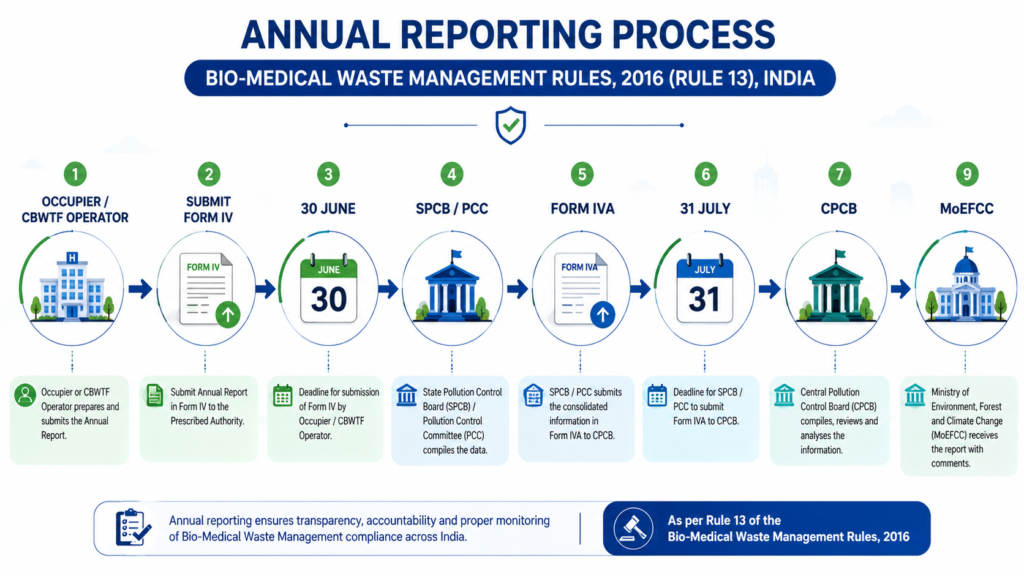
Every occupier/CBWTF operator submits an annual report in Form IV to the prescribed authority by 30th June each year. The prescribed authority compiles and forwards this to CPCB by 31st July. CPCB compiles it further and sends it, with comments, to MoEFCC by 31st August. Annual reports must be published online by occupiers, SPCBs and CPCB.
Rule 14: Maintenance of Records
Every authorised person must maintain records of generation, collection, storage, transport, treatment, disposal and other handling of bio-medical waste for five years, per these rules and any Central Government/CPCB/prescribed authority guidelines. Records are subject to inspection by the prescribed authority or MoEFCC at any time.
Rule 15: Accident Reporting
In case of a major accident, the authorised person must immediately inform the prescribed authority and submit a written report within 24 hours in Form I detailing remedial steps. Details of all other (minor) accidents and remedial action go into the annual report under Rule 13.
Rule 16: Appeal
Anyone aggrieved by a prescribed authority’s order may appeal in Form V to the Secretary (Environment) of the State/UT within 30 days of the order. Appeals against an order of the Director General, Armed Forces Medical Services go to the Secretary, MoEFCC. Late appeals may still be entertained if sufficient cause is shown. Appeals must be disposed of within 90 days of filing.
Rule 17: Site for Common Bio-Medical Waste Treatment and Disposal Facility
The land-assignment department of the State/UT is responsible for providing a suitable site for a common treatment facility. Site selection must be made in consultation with the prescribed authority, other stakeholders, and per MoEFCC/CPCB guidelines.
Rule 18: Liability of the Occupier, Operator of a Facility
Occupiers and CBWTF operators are liable for all damage caused to the environment or the public due to improper handling of bio-medical waste, and are liable to action under Sections 5 and 15 of the Environment (Protection) Act, 1986 for any violation.
Schedule I: Categories, Segregation, Treatment and Disposal
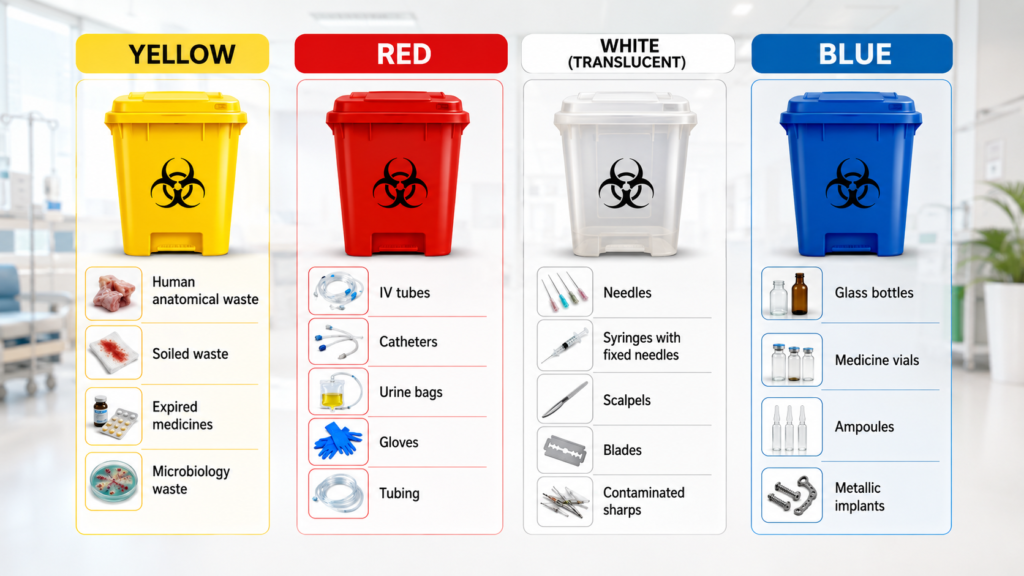
Schedule I sets out four colour-coded categories — Yellow, Red, White (translucent), and Blue — each covering specific waste types, the type of bag/container required, and the permitted treatment/disposal route. The full breakdown, as prescribed in the rules and updated by the 2018 amendment, is below.
| Category | Type of Waste | Type of Bag / Container | Treatment and Disposal Options |
|---|---|---|---|
| Yellow | (a) Human Anatomical Waste: human tissues, organs, body parts and foetus below the viability period (per the Medical Termination of Pregnancy Act, 1971, as amended). | Yellow coloured non-chlorinated plastic bags | Incineration or Plasma Pyrolysis or deep burial* |
| (b) Animal Anatomical Waste: experimental animal carcasses, body parts, organs, tissues, including waste from animals used in experiments/testing in veterinary hospitals, colleges or animal houses. | Yellow coloured non-chlorinated plastic bags | Incineration or Plasma Pyrolysis or deep burial* | |
| (c) Soiled Waste: items contaminated with blood or body fluids — dressings, plaster casts, cotton swabs, bags containing residual/discarded blood and blood components (routine masks and gowns were added to this item by the 2018 amendment). | Yellow coloured non-chlorinated plastic bags | Incineration, Plasma Pyrolysis or deep burial*; where these aren’t available, autoclaving/microwaving/hydroclaving followed by shredding or mutilation, with treated waste sent for energy recovery | |
| (d) Expired or Discarded Medicines: pharmaceutical waste including antibiotics and cytotoxic drugs, plus items and glass/plastic ampoules/vials contaminated with cytotoxic drugs. | Yellow coloured non-chlorinated plastic bags or containers | Cytotoxic drugs/contaminated items go back to the manufacturer for incineration at >1200°C, or to a common facility/hazardous waste facility for incineration at >1200°C, encapsulation, or Plasma Pyrolysis at >1200°C. All other discarded medicines are sent back to the manufacturer or incinerated. | |
| (e) Chemical Waste: chemicals used in producing biologicals, and used/discarded disinfectants. | Yellow coloured containers or non-chlorinated plastic bags | Incineration, Plasma Pyrolysis, or Encapsulation at a hazardous waste treatment, storage and disposal facility | |
| (f) Chemical Liquid Waste: liquid waste from chemical use in producing biologicals, discarded disinfectants, silver X-ray film developing liquid, discarded Formalin, infected secretions, aspirated body fluids, lab liquid and floor washings/housekeeping/disinfecting waste. | Separate collection system leading to an effluent treatment system | After resource recovery, pre-treated before mixing with other wastewater; combined discharge must meet Schedule II/III norms | |
| (g) Discarded linen, mattresses and beddings contaminated with blood or body fluid. | Non-chlorinated yellow plastic bags or suitable packing material | Non-chlorinated chemical disinfection followed by incineration, Plasma Pyrolysis, or energy recovery; where unavailable, shredding/mutilation or sterilization-plus-shredding, then sent for energy recovery or incineration/Plasma Pyrolysis | |
| (h) Microbiology, Biotechnology and other clinical laboratory waste: blood bags, lab cultures/stocks/specimens of micro-organisms, live/attenuated vaccines, human and animal cell cultures, residual toxins, culture dishes and devices. | Autoclave-safe plastic bags or containers (updated by the 2018 amendment to “Autoclave or Microwave or Hydroclave safe”) | Pre-treat/sterilise on-site with non-chlorinated chemicals per WHO or (originally) NACO guidance — updated by the 2018 amendment to WHO’s Safe Management guidance and the WHO Blue Book, 2014 — then incinerate | |
| Red | Contaminated Waste (Recyclable): disposable tubing, bottles, IV tubes and sets, catheters, urine bags, syringes without needles (and fixed-needle syringes/vacutainers with needles cut), and gloves. | Red coloured non-chlorinated plastic bags or containers | Autoclaving or microwaving/hydroclaving followed by shredding or mutilation, then sent to registered/authorised recyclers, for energy recovery, plastic-to-fuel/diesel, or road-making — never to a landfill |
| White (Translucent) | Waste Sharps including Metals: needles, syringes with fixed needles, needle-tip cutter/burner needles, scalpels, blades, or any other contaminated sharp object that can puncture or cut, including used/discarded/contaminated metal sharps. | Puncture-proof, leak-proof, tamper-proof containers | Autoclaving or Dry Heat Sterilization followed by shredding, mutilation, or encapsulation in a metal container/cement concrete (or a combination of shredding and autoclaving), then sent to iron foundries with SPCB/PCC consent, a sanitary landfill, or a designated concrete waste-sharp pit |
| Blue | (a) Glassware: broken, discarded or contaminated glass, including medicine vials and ampoules (except those contaminated with cytotoxic waste). | Cardboard boxes with blue coloured marking (updated by the 2018 amendment to “puncture-proof and leak-proof boxes or containers with blue coloured marking”) | Disinfection (washing with detergent, then Sodium Hypochlorite treatment) or autoclaving/microwaving/hydroclaving, then sent for recycling |
| (b) Metallic Body Implants. | Cardboard boxes with blue coloured marking (updated by the 2018 amendment to “puncture-proof and leak-proof boxes or containers with blue coloured marking”) | Recycling, per the same route as glassware |
*Deep burial is permitted only in rural or remote areas with no access to a common bio-medical waste treatment facility, and only with prior approval from the prescribed authority, following the standards in Schedule III and any Central Pollution Control Board guidelines on locating deep burial sites.
Part 2 of Schedule I adds twelve general conditions that sit on top of the table above: bags must meet Bureau of Indian Standards norms (Plastic Waste Management Rules apply until BIS standards are published); chemical disinfection must use at least 10% Sodium Hypochlorite with 30% residual chlorine for twenty minutes, or an equivalent reagent demonstrating a Log10-4 reduction; mutilation/shredding must be thorough enough to prevent unauthorised reuse; there’s no chemical pre-treatment before incineration except for microbiological, lab and highly infectious waste; toxic incineration ash goes to a hazardous waste facility if it exceeds prescribed limits; a dead foetus below the viability period counts as human anatomical waste and must go to the common facility in a yellow bag with the official MTP certificate attached; cytotoxic drug vials can never be handed to an unauthorised person and go back to the manufacturer first, or to a common facility/TSDF/Plasma Pyrolysis at >1200°C as a second option; residual chemical waste, disinfectants and chemical sludge go to a hazardous waste facility via the CBWTF operator; lab, microbiological and blood waste must be disinfected/sterilised per WHO or NACO guidance before reaching the common facility; in-house incinerators are not allowed unless there’s no nearby common facility (and even then only with State Pollution Control Board authorisation); syringes must be mutilated or have their needles cut and stored in tamper-proof, leak-proof, puncture-proof containers; and household bio-medical waste must be segregated the same way and handed to municipal collectors, with Urban Local Bodies tying up with a CBWTF for final disposal.
Schedule II: Standards for Treatment and Disposal
Schedule II lays down detailed operating and emission standards for: incineration (combustion efficiency ≥99%, primary chamber ≥800°C, secondary chamber 1050°C ±50°C, 2-second gas residence time, and specific emission limits for particulate matter, NOx, HCl, Dioxins/Furans, and Mercury, plus a minimum 30-metre stack height); plasma pyrolysis/gasification (similar combustion and emission benchmarks); autoclaving (specific temperature/pressure/time combinations for gravity and vacuum autoclaves, validation and routine spore testing); microwaving; deep burial (pit depth, lime covering, groundwater table distance); chemical disinfection efficacy (4 Log10 reduction); dry heat sterilisation for sharps; and permissible limits for liquid effluent discharge (pH, suspended solids, oil & grease, BOD, COD, bio-assay survival).
Schedule III: List of Prescribed Authorities and Corresponding Duties
Schedule III lists seven categories of authorities — MoEFCC, Central/State Health & Family Welfare and Animal Husbandry Ministries/Departments, Ministry of Defence, CPCB, State Government/UT Administration, State Pollution Control Boards/Pollution Control Committees, and Municipalities/Corporations/Urban Local Bodies/Gram Panchayats — with the specific duties assigned to each.
Schedule IV: Labels
Schedule IV Part A prescribes the Biohazard symbol and Cytotoxic Hazard symbol labels (with “Handle with Care”) for bio-medical waste containers/bags. Part B prescribes the label format for transporting waste bags/containers, including date of generation, waste category number, quantity, sender/receiver details, and an emergency contact — the label must be non-washable and prominently visible.
Forms I–V
The rules prescribe five forms: Form I (Accident Reporting), Form II (Application for Authorisation/Renewal), Form III (Authorisation), Form IV (Annual Report), and Form V (Appeal). Full details are in the Forms & Formats table below.
Definitions
| Term | Plain-English Meaning |
|---|---|
| Act | The Environment (Protection) Act, 1986. |
| Animal house | A place where animals are kept for experiments or testing. |
| Authorisation | Permission granted by the prescribed authority to generate, collect, store, transport, treat, process, dispose or otherwise handle bio-medical waste. |
| Authorised person | An occupier or operator who has been given authorisation by the prescribed authority. |
| Biological | Any preparation made from organisms/micro-organisms or products of metabolism/biochemical reactions, used for diagnosis, immunisation, treatment or related research. |
| Bio-medical waste | Any waste generated during diagnosis, treatment or immunisation of humans/animals, related research, production/testing of biologicals, or health camps — including the categories in Schedule I. |
| Bio-medical waste treatment and disposal facility | Any facility where bio-medical waste is treated or disposed, including common treatment facilities. |
| Form | A Form appended to the rules. |
| Handling | Generation, sorting, segregation, collection, use, storage, packaging, loading, transport, unloading, processing, treatment, destruction, conversion, sale, transfer or disposal of bio-medical waste. |
| Health care facility | Any place providing diagnosis, treatment or immunisation to humans or animals, regardless of size/type, plus related research activity. |
| Major accident | An accident during bio-medical waste handling that could affect large numbers of the public (e.g., a waste truck toppling, accidental release into a water body) — excludes needle-prick injuries and mercury spills. |
| Management | All steps needed to ensure bio-medical waste is managed to protect health and the environment. |
| Occupier | The person with administrative control over the premises generating bio-medical waste (hospital, clinic, lab, etc.), regardless of the medicine system practised. |
| Operator of a common bio-medical waste treatment facility | A person who owns or controls a CBWTF for collecting, storing, transporting, treating, disposing or otherwise handling bio-medical waste. |
| Prescribed authority | The State Pollution Control Board (for a State) or Pollution Control Committee (for a Union territory). |
| Schedule | A Schedule appended to the rules. |
Scope & Applicability
These rules apply to:
- All persons who generate, collect, receive, store, transport, treat, dispose or handle bio-medical waste, including hospitals, nursing homes, clinics, dispensaries, veterinary institutions, animal houses, pathological laboratories, blood banks, ayush hospitals, clinical establishments, research/educational institutions, health camps, medical/surgical camps, vaccination camps, blood donation camps, school first-aid rooms, forensic laboratories and research labs.
They do not apply to:
- Radioactive wastes (Atomic Energy Act, 1962)
- Hazardous chemicals (Manufacture, Storage and Import of Hazardous Chemicals Rules, 1989)
- Solid wastes (municipal solid waste rules)
- Lead-acid batteries (Batteries (Management and Handling) Rules, 2001)
- Hazardous wastes (Hazardous Wastes Rules)
- E-waste (E-Waste Rules)
- Hazardous micro-organisms, genetically engineered micro-organisms and cells (1989 Rules)
Roles & Responsibilities
Occupier
- Ensure safe handling, storage, segregation, pre-treatment and disposal of waste as detailed in Rule 4.
- Train and immunise staff, maintain a daily waste register, and publish monthly/annual data online.
- Report major accidents in Form I and maintain records for five years.
Operator of a Common Bio-Medical Waste Treatment Facility (CBWTF)
- Collect, transport, treat and dispose of waste from occupiers safely and on schedule, including on holidays.
- Train and immunise its own workers, maintain treatment log books, and publish authorisation/treatment/annual report details online.
- Send post-treatment recyclables only to authorised recyclers.
Prescribed Authority (State Pollution Control Board / Pollution Control Committee)
- Grant, renew, refuse or cancel authorisations (Rules 9 and 10).
- Perform the duties listed against it in Schedule III.
Director General, Armed Forces Medical Services
- Act as the prescribed authority for Armed Forces health care establishments under the Ministry of Defence.
Advisory Committee (State/UT and Defence)
- Oversee rule implementation, meet every six months, and recommend improvements.
District Level Monitoring Committee
- Monitor compliance in health care facilities and common treatment facilities within the district, and report every six months to the State Advisory Committee.
Ministry of Environment, Forest and Climate Change (MoEFCC)
- Review rule implementation annually and receive compiled reports from CPCB.
Central Pollution Control Board (CPCB)
- Compile and analyse SPCB data, monitor Armed Forces facility compliance, and forward annual reports to MoEFCC.
Municipalities / Corporations / Urban Local Bodies / Gram Panchayats
- Allocate land for common treatment facilities and collect non-bio-medical solid waste from health care facilities.
Forms & Formats
| Form | Purpose | Who Files It |
|---|---|---|
| Form I | Accident Reporting | Occupier / CBWTF operator (to the prescribed authority) |
| Form II | Application for Authorisation or Renewal of Authorisation | Occupier of health care facility / CBWTF operator |
| Form III | Authorisation (granted by the prescribed authority) | Issued by the prescribed authority to the occupier/operator |
| Form IV | Annual Report | Occupier / CBWTF operator (to the prescribed authority, by 30th June) |
| Form IVA (added by the 2018 amendment) | Format for submission of consolidated annual report information | State Pollution Control Boards / Pollution Control Committees and Director General, Armed Forces Medical Services (to CPCB) |
| Form V | Appeal against an order of the prescribed authority | Any aggrieved person |
Compliance Requirements
- Register and obtain authorisation in Form II/Form III via the prescribed authority (Rule 10).
- Maintain a day-to-day bio-medical waste management register and publish monthly data online (Rule 4(n)).
- Submit an Annual Report in Form IV by 30th June every year (Rule 13).
- Maintain all handling/treatment/disposal records for five years (Rule 14).
- Report major accidents within 24 hours in Form I (Rule 15).
- Publish the Annual Report on the facility’s own website, and set up a website within two years of notification (Rule 4(p)).
- Phase out chlorinated plastic bags, gloves and blood bags within two years of notification (Rule 4(d)).
- Set up a bar-code system within one year of notification (Rule 4(i)).
- Existing incinerators to meet Schedule II standards within two years (Rule 4(t)).
- Constitute/participate in a review and monitoring committee meeting at least once every six months (Rule 4(r)).
Penalties
The rules do not prescribe a separate schedule of penalty amounts. Instead, Rule 18 states that the occupier or operator of a common bio-medical waste treatment facility is liable for all damages caused to the environment or the public due to improper handling of bio-medical waste, and is liable to action under Sections 5 and 15 of the Environment (Protection) Act, 1986 in case of any violation.
Latest Amendments
Bio-Medical Waste Management (Amendment) Rules, 2018 — G.S.R. 234(E), dated 16th March 2018
- Updated cross-references in Rule 2(2) to newer waste laws: “Municipal Solid Waste (Management and Handling) Rules, 2000” became “Solid Waste Management Rules, 2016”; “Hazardous Wastes (Management, Handling and Transboundary Movement) Rules, 2008” became “Hazardous and Other Wastes (Management and Transboundary Movement) Rules, 2016”; and “E-Waste (Management and Handling) Rules, 2011” became “E-Waste (Management) Rules, 2016”.
- Rule 4(c): pre-treatment of lab/microbiological/blood waste must now follow WHO’s “Safe management of wastes from health care activities” guidance and the WHO Blue Book, 2014.
- Rule 4(d): chlorinated plastic bags (excluding blood bags) and gloves to be phased out by 27th March 2019.
- Rule 4(i): the one-year bar-code deadline was replaced with a requirement to follow CPCB guidelines for further treatment and disposal by 27th March 2019.
- Rule 4(p): all health care facilities (any number of beds) must publish their annual report online within two years of this amendment’s publication.
- Rule 5(c): the one-year deadline for bar-coding/GPS by CBWTF operators was likewise replaced with a CPCB-guideline-based deadline of 27th March 2019.
- Rule 7(8): “phase out non-chlorinated plastic bags” was corrected to “phase out chlorinated plastic bags”; reference updated from Plastic Waste Management Rules, 2011 to the 2016 Rules.
- Rule 13(2): SPCBs/PCCs must now submit data to CPCB in the newly-added Form IVA.
- Schedule I: “routine mask and gown” added to the soiled-waste (yellow) category; microbiology/lab waste bags updated to “Autoclave or Microwave or Hydroclave safe”; pre-treatment guidance updated to WHO’s Blue Book, 2014; sharps/glassware (blue category) containers must now be puncture-proof and leak-proof; chemical disinfection strength changed from 10% to 1–2%.
- Schedule II: emission standard units corrected from “mgNm3” to “mg/Nm3”; new notes added for liquid waste standards, including a 31st December 2019 deadline for facilities with fewer than 10 beds to install a Sewage Treatment Plant.
- Schedule III: cross-references to “(Rule 9)” corrected to “(Rule 10)” and “(Rule 12)” against serial numbers 3 and 4.
- Form IVA was newly inserted after Form IV — a consolidated annual reporting format for SPCBs/PCCs and the Armed Forces Medical Services to submit to CPCB by 31st July each year.
Bio-Medical Waste Management (Amendment) Rules, 2019 — G.S.R. 129(E), dated 19th February 2019
- Rule 4(n) revised: bedded health care units (of any number of beds) must maintain and update the waste register daily and display monthly records online, by category and colour-coding per Schedule I.
- Rule 4(p) revised: all bedded health care facilities (any number of beds) must publish their annual report online within two years of the 2018 amendment’s publication.
- Schedule II, serial 8, Note 3: facilities with fewer than 10 beds must meet liquid waste discharge standards by 31st December 2019.
- Schedule III, serial 3: a new item (viii) added — inspection and monitoring of MI rooms, sick bays on ships/submarines, station medical centres and field hospitals, performed by the Director General, Armed Forces Medical Services.
- Schedule III, serial 4, item (viii) revised: inspection/monitoring of health care facilities other than those covered above is performed by the Director General, Armed Forces Medical Services under Rule 9.
Bio-Medical Waste Management (Second Amendment) Rules, 2019 — G.S.R. 360(E), dated 10th May 2019
- Rule 4(d): an Explanation was inserted clarifying that “chlorinated plastic bags” (which must be phased out) do not include urine bags, effluent bags, abdominal bags, or chest drainage bags.
- Schedule III, serial 3, item (viii): numbering corrected from “(viii)” to “(vii)”.
Practical Industry Examples
Because Rule 2(1) explicitly extends the rules to hospitals, nursing homes, clinics, dispensaries, veterinary institutions, animal houses, pathological laboratories, blood banks, ayush hospitals, clinical establishments, research or educational institutions, health camps, medical/surgical camps, vaccination camps, blood donation camps, school first-aid rooms, forensic laboratories and research labs, all of these fall directly within scope. Schedule I’s four waste categories further point to specific affected operations: facilities generating human/animal anatomical waste or soiled dressings (surgical hospitals, veterinary colleges), facilities using cytotoxic drugs (oncology units), facilities running microbiology or biotechnology cultures (pathology and research labs), and any facility using sharps (virtually every clinical setting). Common Bio-Medical Waste Treatment Facility (CBWTF) operators — the incineration, autoclaving, and plasma pyrolysis service providers named throughout Rules 5, 7 and 8 — are also directly and centrally covered.
Compliance Checklist
- ☐ Obtain authorisation in Form II/Form III from the State Pollution Control Board or Pollution Control Committee.
- ☐ Segregate waste at source into Yellow/Red/White/Blue bags and containers per Schedule I.
- ☐ Maintain a daily bio-medical waste register and publish monthly data online.
- ☐ Submit the Annual Report in Form IV by 30th June every year.
- ☐ Maintain all handling/treatment/disposal records for five years.
- ☐ Report major accidents in Form I within 24 hours.
- ☐ Ensure chlorinated plastic bags/gloves (excluding urine, effluent, abdominal and chest drainage bags) are phased out.
- ☐ Confirm any facility under 10 beds meets liquid waste/Sewage Treatment Plant standards by 31st December 2019.
- ☐ Set up/participate in a waste management review committee meeting every six months.
- ☐ Train and immunise all staff handling bio-medical waste at induction and annually.
Process Flow
Authorisation Process (Rule 10)
Step 1: Occupier/operator submits Form II application to the prescribed authority (SPCB/PCC).
↓
Step 2: Prescribed authority reviews and disposes of the application within 90 days.
↓
Step 3: If not objected to within 90 days (non-bedded occupiers), authorisation is deemed granted.
↓
Step 4: Prescribed authority issues provisional authorisation in Form III, synced with Water/Air Act consent validity.
↓
Step 5: Any change in waste activity requires a fresh Form II application for modification.
Annual Reporting Chain (Rule 13)
Step 1: Occupier/CBWTF operator files Form IV with the prescribed authority by 30th June.
↓
Step 2: Prescribed authority compiles and sends data to CPCB (in Form IVA) by 31st July.
↓
Step 3: CPCB compiles, reviews and forwards the information with comments to MoEFCC by 31st August.
Appeal Process (Rule 16)
Step 1: Aggrieved person files an appeal in Form V within 30 days of the order.
↓
Step 2: Appeal goes to the Secretary (Environment) of the State/UT, or to the Secretary, MoEFCC if the order was passed by the Director General, Armed Forces Medical Services.
↓
Step 3: Authority may condone delay for sufficient cause.
↓
Step 4: Appeal is disposed of within 90 days of filing.
FAQs
What are the Bio-Medical Waste Management Rules, 2016?
They are rules notified by MoEFCC on 28th March 2016 (G.S.R. 343(E)) governing the generation, segregation, storage, transport, treatment and disposal of bio-medical waste in India, replacing the 1998 rules.
Who do these rules apply to?
All persons handling bio-medical waste, including hospitals, nursing homes, clinics, veterinary institutions, animal houses, pathological labs, blood banks, ayush hospitals, research institutions, health camps and vaccination/blood donation camps.
What waste is excluded from these rules?
Radioactive waste, hazardous chemicals, municipal solid waste, lead-acid batteries, hazardous wastes, e-waste, and hazardous/genetically engineered micro-organisms — each already governed by its own separate rules.
How many waste categories are there under Schedule I?
Four: Yellow, Red, White (translucent) and Blue, each with defined waste types, container requirements, and treatment/disposal methods.
Who is the prescribed authority under these rules?
The State Pollution Control Board for States and the Pollution Control Committee for Union territories; for Armed Forces health facilities, it is the Director General, Armed Forces Medical Services.
By when must the Annual Report be filed?
Every occupier and CBWTF operator must submit Form IV to the prescribed authority on or before 30th June every year, covering the preceding calendar year.
How long must bio-medical waste records be kept?
Every authorised person must maintain records related to bio-medical waste handling for a period of five years, per Rule 14.
What is the deadline for phasing out chlorinated plastic bags?
The 2018 amendment set 27th March 2019 as the phase-out deadline for chlorinated plastic bags and gloves (excluding blood bags). The 2019 Second Amendment further clarified that urine bags, effluent bags, abdominal bags and chest drainage bags are not covered by this phase-out.
What is Form IVA and who files it?
Form IVA, inserted by the 2018 amendment, is a consolidated annual reporting format that State Pollution Control Boards/Pollution Control Committees and the Director General, Armed Forces Medical Services must submit to CPCB by 31st July each year.
What accident-reporting timeline applies to major accidents?
The authorised person must immediately intimate the prescribed authority and submit a written report within 24 hours in Form I detailing the remedial steps taken.
What is the liquid waste compliance deadline for small health care facilities?
Per the February 2019 amendment, health care facilities with fewer than ten beds must meet the output discharge standard for liquid waste (Schedule II) by 31st December 2019.
Can an occupier install its own on-site incinerator?
No, not if a common bio-medical waste treatment facility is available within 75 kilometres. In-house incinerators are only permitted where no such common facility is nearby, and only after authorisation from the State Pollution Control Board.
How is an appeal filed against a prescribed authority’s order?
In Form V, within 30 days of the order being communicated, to the Secretary (Environment) of the State/UT, or to the Secretary, MoEFCC if the order was passed by the Director General, Armed Forces Medical Services.
What penalty applies for violating these rules?
The rules themselves do not set a specific penalty amount; Rule 18 makes the occupier/operator liable for environmental and public damage and liable to action under Sections 5 and 15 of the Environment (Protection) Act, 1986.
Conclusion
The Bio-Medical Waste Management Rules, 2016, as refined by the 2018 and 2019 amendments, set out a complete lifecycle framework — from colour-coded segregation at the point of generation through authorisation, treatment, disposal, record-keeping and annual reporting — that every occupier and common treatment facility operator in India’s health care system must follow, with the SPCB/PCC (or the Director General, Armed Forces Medical Services for defence establishments) as the enforcing authority.
Official References
- Bio-Medical Waste Management Rules, 2016 — G.S.R. 343(E), dated 28th March 2016, Ministry of Environment, Forest and Climate Change, Gazette of India, Extraordinary, Part II, Section 3, Sub-section (i).
- Bio-Medical Waste Management (Amendment) Rules, 2018 — G.S.R. 234(E), dated 16th March 2018, Ministry of Environment, Forest and Climate Change, Gazette of India, Extraordinary, Part II, Section 3, Sub-section (i).
- Bio-Medical Waste Management (Amendment) Rules, 2019 — G.S.R. 129(E), dated 19th February 2019, Ministry of Environment, Forest and Climate Change, Gazette of India, Extraordinary, Part II, Section 3, Sub-section (i).
- Bio-Medical Waste Management (Second Amendment) Rules, 2019 — G.S.R. 360(E), dated 10th May 2019, Ministry of Environment, Forest and Climate Change, Gazette of India, Extraordinary, Part II, Section 3, Sub-section (i).
Explore More Environment Compliance Articles
Looking for more environmental laws, waste management rules, CPCB guidelines and EHS compliance resources? Browse our complete collection of environment-related articles here: