CAPA vs Capability – Did We Just Close the Action or Transform the Organization?
PDF · 8 pages · English · Incident Investigation
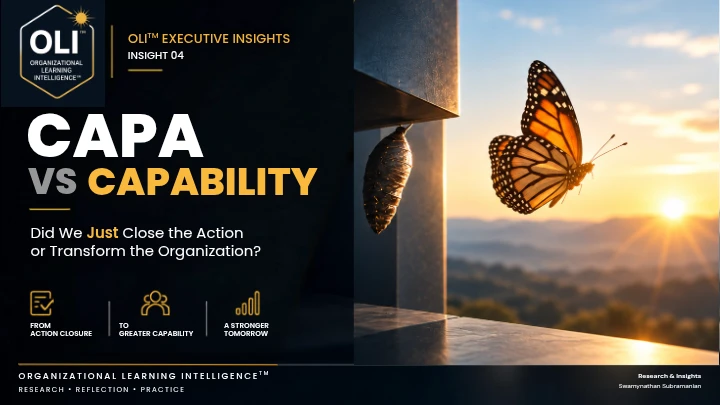
An 8-page OLI Executive Insight explaining the difference between closing corrective actions and building lasting organizational capability through learning, stronger systems, improved behaviours and cross-functional application of lessons.
By Swamynathan Subramanian Research & Insights Organizational Learning Intelligence (OLI) · Published 2026-10-02 · Updated 2026-11-15
From the document
Research & Insights Swamynathan Subramanian INSIGHT 04 CAPA CAPABILITY Did We Just Close the Action or Transform the Organization? FROM ACTION CLOSURE TO GREATER CAPABILITY A STRONGER TOMORROW O R G A N I Z A T I O N A L L E A R N I N G I N T E L L I G E N C E T M R E S E A R C H • R E F L E C T I O N • P R A C T I C E VS OLI EXECUTIVE INSIGHTS TM
OUR INSIGHTS SO FAR... A connected journey — from measurement to transformation. Each insight builds on the previous one, helping us think deeper about what really drives a safer, stronger tomorrow. BEYOND TRIR Are we measuring enough? Traditional outcome measures like TRIR are important, but they don’t tell the full story. Look beyond outcomes to understand the bigger picture. LEARNING VELOCITY TM How quickly do we learn? It’s not just what happens, but how fast we learn from it that makes a difference. Faster learning helps us prevent recurrence and adapt to new risks. THE FORGOTTEN KPI How much more capable are we becoming? We measure outcomes. We track activities. But the capability we build through learning is rarely measured. Organizational capability is the missing KPI. CAPA VS CAPABILITY Did we just close the action or transform …
capa · corrective action · preventive action · capa management · capa effectiveness · organizational capability · organizational learning · organizational learning intelligence · oli · safety leadership
Read CAPA vs Capability – Did We Just Close the Action or Transform the Organization? online
- Accident and Incident Investigation, FMEA and Risk Assessment
210-slide training deck. Covers why and how to investigate accidents and near misses, the accident ratio pyramids, and the causation model (immediate and basic causes). It also co…
- 5 Why Analysis – History & Methodology
A concise visual guide explaining the history, methodology, worked example, rules, strengths and limitations of the 5 Why Root Cause Analysis technique.
- 5 Why Root Cause Analysis – Worksheet
A practical 5 Why Root Cause Analysis worksheet for identifying root causes, validating causal chains and developing corrective and preventive actions.
- Accident Investigation Techniques – Second Edition
A comprehensive reference on accident investigation covering accident theories, evidence gathering, analytical techniques, causal factors, corrective actions, reporting and lesson…
- Accident Investigation Techniques – Theory & Concepts
Study deck covering accident theory, causation models, root cause analysis, analytical techniques, corrective actions and accident prevention.
- Accident and Incident Investigation Guide (Based on HSE HSG245)
A comprehensive guide on workplace accident and incident investigation based on HSE HSG245. This document explains the investigation process, root cause analysis, immediate and un…
- Safety Incident Report Form – Incident Recording, Investigation and Preventive Actions
A practical Excel-based Safety Incident Report Form for recording workplace incidents, identifying contributing factors, documenting immediate actions and planning preventive meas…
- Accident Investigation – OSHA/HSE/DC Safety Training Handbook
A 55-page accident investigation training handbook covering accident causes, investigation principles, evidence collection, witness interviews, root-cause analysis, corrective act…
