Fault Tree Analysis (FTA) and Event Tree Analysis (ETA) – NEBOSH National Diploma Unit A
PDF · 9 pages · English · Risk Assessment
A 9-page NEBOSH National Diploma Unit A learning resource explaining Fault Tree Analysis (FTA) and Event Tree Analysis (ETA), including their principles, applications, logic gates, quantitative calculations and practical fire and explosion examples.
By RRC Training · Published 2026-10-01 · Updated 2026-11-15
From the document
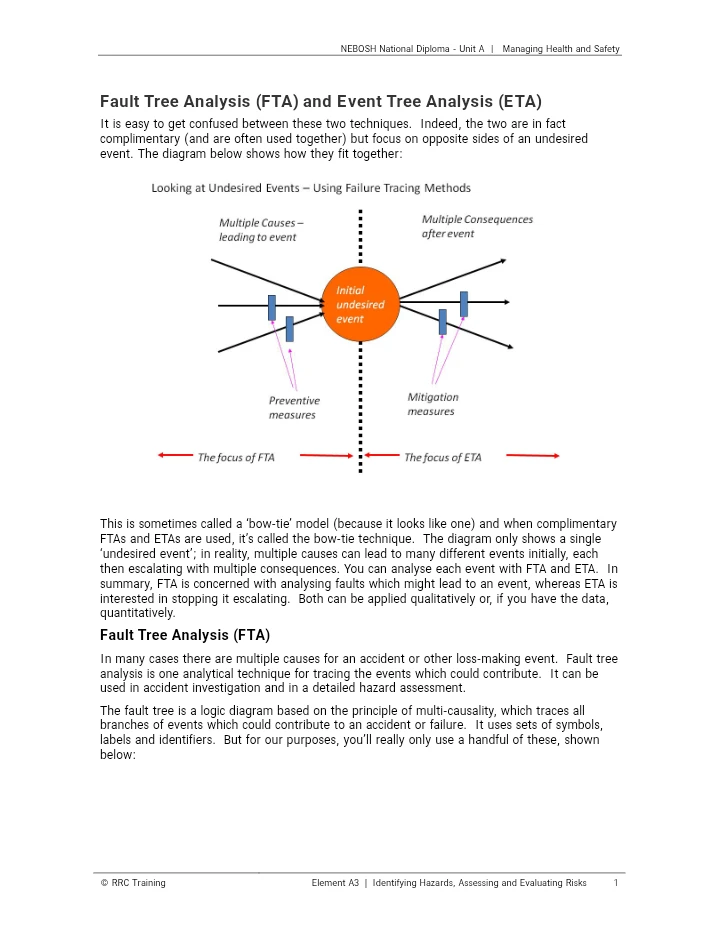
NEBOSH National Diploma - Unit A | Managing Health and Safety © RRC Training Element A3 | Identifying Hazards, Assessing and Evaluating Risks 1 Fault Tree Analysis (FTA) and Event Tree Analysis (ETA) It is easy to get confused between these two techniques. Indeed, the two are in fact complimentary (and are often used together) but focus on opposite sides of an undesired event. The diagram below shows how they fit together: This is sometimes called a ‘bow-tie’ model (because it looks like one) and when complimentary FTAs and ETAs are used, it’s called the bow-tie technique. The diagram only shows a single ‘undesired event’; in reality, multiple causes can lead to many different events initially, each then escalating with multiple consequences. You can analyse each event with FTA and ETA. In summary, FTA is concerned with analysing faults which might lead to an event, whereas ETA is interested in stopping it escalating. Both can be applied qualitatively or, if you have the data, quantitatively. Fault Tree Analysis (FTA) In many cases there are multiple causes for an accident or other loss-making event. Fault tree analysis is one analytical technique for tracing the events which …
fault tree analysis · fta · event tree analysis · eta · bow tie analysis · risk assessment · risk analysis · quantitative risk assessment · qra · qualitative risk assessment
Read Fault Tree Analysis (FTA) and Event Tree Analysis (ETA) – NEBOSH National Diploma Unit A online
- IS 15656:2006 – Hazard Identification and Risk Analysis – Visual Handbook
A visual, clause-by-clause handbook on IS 15656:2006 covering hazard identification, risk analysis, HAZOP, FMEA, FTA, ETA, consequence analysis and risk assessment techniques.
- Risk Assessment Training – Risk Management & Control
A 36-page Risk Assessment Training presentation covering hazard identification, risk evaluation, legal requirements, risk control, hierarchy of controls, ALARP, risk matrices, add…
- NEBOSH General International Certificate in Occupational Health & Safety – Unit GIC2 Risk Assessment Study Text
A comprehensive 273-page study text for NEBOSH General International Certificate in Occupational Health & Safety, Unit GIC2 – Risk Assessment. The guide provides structured learni…
- How to Make a Bow Tie – An Introduction to Process Safety
A 55-page process safety training presentation introducing Bow Tie Analysis and its application to major accident hazards, loss of containment, threats, preventive and mitigatory…
- Method Statement and Risk Assessment (MSRA) – Template for Construction and HSE Activities
A 19-page Method Statement and Risk Assessment (MSRA) template for construction and industrial projects. It provides a structured format for defining work scope, assigning respons…
- Warehousing Risk Management Guide
A practical 24-page guide covering key risk management issues in warehousing, including fire safety, hot work, flooding, security, worker safety, forklifts, material storage, pall…
- ALARP for Engineers: A Technical Safety Guide
A technical safety guide explaining the principles and practical application of ALARP (As Low As Reasonably Practicable) and SFAIRP (So Far As Is Reasonably Practicable) in engine…
- Guidelines for Performing Effective Pre-Startup Safety Reviews (PSSR)
A technical reference published by the Center for Chemical Process Safety (CCPS) of the American Institute of Chemical Engineers (AIChE), in collaboration with John Wiley & Sons.…
