Hazardous Waste Identification, Compatibility, Sampling and Management
PDF · 46 pages · English · Environmental Management
A technical presentation covering hazardous waste identification, compatibility assessment, sampling, testing, safe handling, treatment and disposal, with reference to HOWM Rules, 2016, CPCB guidelines and US EPA methods.
By Unknown · Published 2026-11-01 · Updated 2026-11-01
From the document
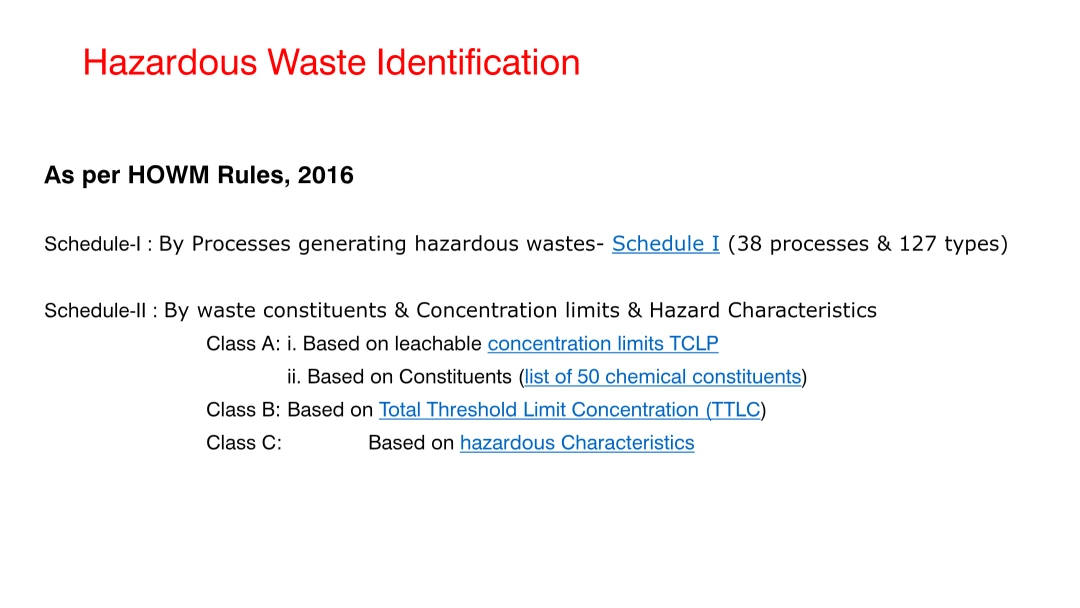
Hazardous Waste Identification As per HOWM Rules, 2016 Schedule - I : By Processes generating hazardous wastes - Schedule I (38 processes & 127 types) Schedule - II : By waste constituents & Concentration limits & Hazard Characteristics Class A: i. Based on leachable concentration limits TCLP ii. Based on Constituents ( list of 50 chemical constituents ) Class B: Based on Total Threshold Limit Concentration (TTLC ) Class C: Based on hazardous Characteristics
Class C: Based on hazardous Characteristics Class C1: Flammable ( flammable vapour at < 60 ° C ) Class C2: Corrosive (pH < 2 or > 12.5) Class C3: Reactive or explosive Class C4: Toxic Class C5: Substances or Wastes liable to spontaneous combustion Class C6: Substances or Wastes which, in contact with water emit flammable gases Class C7: Oxidizing Class C8: Organic Peroxides Class C9: Poisons (acute) . — Class C10: Infectious substances Class C11: Liberation of toxic gases in contact with air or water Class C12: Eco - toxic Class C13: Capable, by any means, after disposal, of yielding another material, e.g., leachate Hazardous Waste Identification
HOWM Rules, 2016 - Reactive Hazardous wastes Class C3: Reactive or explosive . — …
hazardous waste · hazardous waste management · waste identification · howm rules 2016 · cpcb guidelines · waste compatibility · chemical incompatibility · reactive waste · pyrophoric waste · hazardous waste sampling
Read Hazardous Waste Identification, Compatibility, Sampling and Management online
- ESG Policy Templates for MSMEs
A 21-page practical ESG policy template kit for MSMEs covering environmental, social and governance topics, including energy, water, waste, occupational health and safety, human r…
- MPCB Circular – Classification of Industrial Sectors into Red, Orange, Green, White and Blue Categories Based on Environmental Pollution Index (EPI)
A 15-page official circular issued by the Maharashtra Pollution Control Board (MPCB) establishing the classification of industrial sectors and activities into Red, Orange, Green,…
- ISO 14001:2026 vs ISO 14001:2015 – Clause-by-Clause Comparison
A 19-page comprehensive clause-by-clause comparison of ISO 14001:2026 and ISO 14001:2015, highlighting unchanged, editorial, modified, new and deleted requirements, along with tra…
- Environmental Impact Assessment Notification, 2006 – Amendment for Ports, Harbours, Breakwaters and Dredging
Gazette of India notification S.O. 5189(E), dated 21 September 2026, amending the Environmental Impact Assessment Notification, 2006 to revise the validity period of prior Environ…
- CGWA Legal Compliance & Six-Monthly Compliance Framework
A practical guide covering CGWA groundwater compliance, NOC requirements, six-monthly returns, water monitoring, rainwater harvesting, wastewater recycling, documentation and enfo…
- Classification of Sectors into Red, Orange, Green, White and Blue Categories – CPCB 2025
Central Pollution Control Board (CPCB) report presenting the revised 2025 methodology for classification of industrial and other sectors into Red, Orange, Green, White and Blue ca…
- Portal Fees under Solid Waste Management Rules, 2026
A 7-page compliance explainer on portal fees under the Solid Waste Management Rules, 2026, covering CPCB portal registration fees, annual processing fees, obligated entities, capa…
- Guidelines on the Environmentally Sound Management of Category III Multilayered Plastic Packaging Waste
CPCB draft guidelines for the environmentally sound management of Category III multilayered plastic packaging (MLP) waste, covering collection, segregation, channelization, recycl…
