TOOLBOX TALK – CONFINED SPACE
PDF · 5 pages · English · Occupational Safety
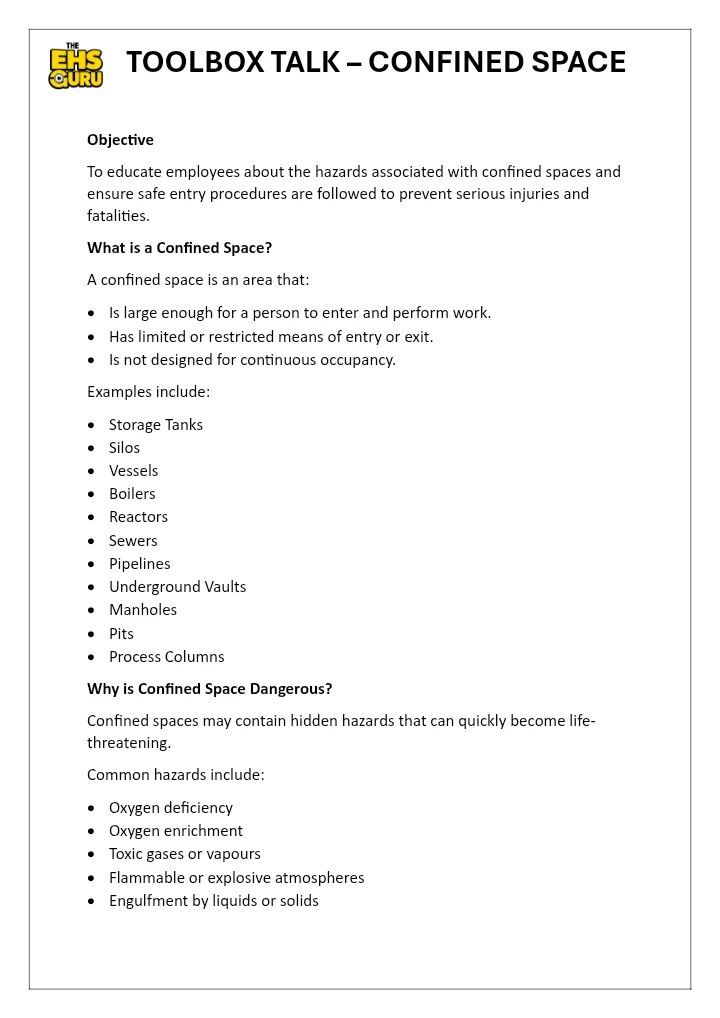
A practical 5-page toolbox talk covering confined space hazards, entry permit requirements, atmospheric testing, energy isolation, ventilation, standby attendants, PPE, communication and emergency rescue preparedness.
By Saurabh Rawat · Published 2026-09-30 · Updated 2026-11-12
From the document
TOOLBOX TALK – CONFINED SPACE Objective To educate employees about the hazards associated with confined spaces and ensure safe entry procedures are followed to prevent serious injuries and fatalities. What is a Confined Space? A confined space is an area that: • Is large enough for a person to enter and perform work. • Has limited or restricted means of entry or exit. • Is not designed for continuous occupancy. Examples include: • Storage Tanks • Silos • Vessels • Boilers • Reactors • Sewers • Pipelines • Underground Vaults • Manholes • Pits • Process Columns Why is Confined Space Dangerous? Confined spaces may contain hidden hazards that can quickly become life- threatening. Common hazards include: • Oxygen deficiency • Oxygen enrichment • Toxic gases or vapours • Flammable or explosive atmospheres • Engulfment by liquids or solids
TOOLBOX TALK – CONFINED SPACE • Moving machinery • Electrical hazards • Heat stress • Poor visibility • Restricted escape routes Many confined space fatalities occur because untrained workers attempt rescue without proper equipment. Common Hazardous Gases Workers should be aware of hazardous gases that may be present inside confined spaces. • Oxygen …
confined space · confined space safety · confined space entry · entry permit · confined space permit · atmospheric testing · gas testing · gas monitoring · oxygen deficiency · h2s
Read TOOLBOX TALK – CONFINED SPACE online
- Total Fall Distance (TFD) Calculation - Lanyard Fall Arrest
Diagram showing Total Fall Distance in fall arrest: 6 ft lanyard + 3.5 ft deceleration + 6 ft user height + 3 ft safety factor = 18.5 ft from the anchorage. Use it to check fall c…
- ADNOC Work Management System (WMS) – Learners Pack
A 49-page ADNOC Work Management System Learners Pack containing practical forms, certificates, exercises and worked examples for Permit to Work (PTW), Job Safety Analysis (JSA), E…
- Occupational Safety and Health (Factories) Standards, 2022
A comprehensive 523-page reference document covering the Occupational Safety and Health (Factories) Standards, 2022, including factory safety requirements, hazardous processes, ma…
- Tool Box Talk
Tool Box Talk Keep all access ways, emergency exits, and work areas clean and obstruction-free. Identify hazards before starting work, use required PPE, follow SOP/PTW, and never…
- Safety Culture Maturity Model - 5 Levels
Emerging se Continually Improving tak safety culture ke 5 maturity levels, Keil Centre 1999 framework ke reference ke saath.
- All Safety Work and Their Precautions – EHS Safety Handbook
A practical visual safety handbook covering major workplace activities, their hazards and essential precautions for safe work execution.
- NEBOSH IGC – Unit GIC1: Management of Health & Safety
A 167-page study text for NEBOSH International General Certificate Unit GIC1. It covers the four elements of Management of Health and Safety, with case studies and exam skills gui…
- Saudi Aramco Safety Handbook – Minimum Safety Rules
A comprehensive safety handbook covering Saudi Aramco minimum safety rules, lifesaving rules, operational safety processes and major workplace safety topics.
