


An Act to regulate the manufacture, possession, use, sale, transport, import and export of explosives, extending to the whole of India, originally enacted in 1884 and substantially amended by the Indian Explosives (Amendment) Act, 1978 (Act 32 of 1978), effective 2 March 1983.
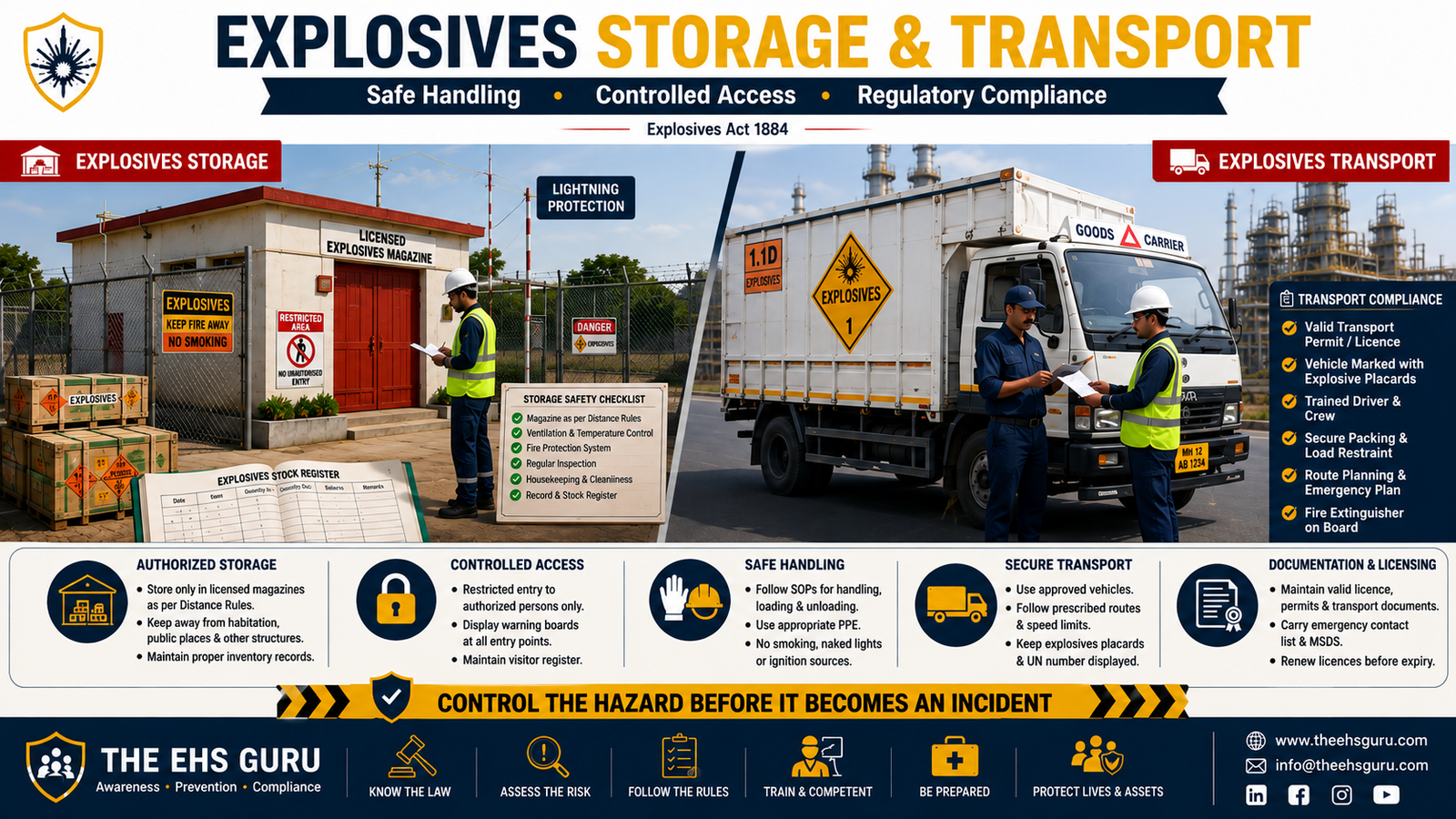
The Explosives Act, 1884 is the oldest piece of hazard-specific legislation still in force in India, and it remains the parent Act for every explosive-handling licence, storage rule and transport requirement issued since. This guide takes a section-by-section look at the Act, its 1978 amendment, and what it means in practice for anyone who manufactures, stores, transports, imports, exports or uses explosives.
1. Legislative Background and Objective
- The Act was originally passed in 1884 to bring the manufacture, possession, use, sale, transport and importation of explosives under a licensing regime.
- It was substantially restructured by the Indian Explosives (Amendment) Act, 1978, effective 2 March 1983. This amendment renumbered several provisions, inserted new sections (5-A, 6-A to 6-F, 9-B, 9-C, 17-A), and removed the word “Indian” from the Act’s short title.
- The Act extends to the whole of India (Section 1) and comes into force on a date the Central Government fixes by notification in the Official Gazette (Section 2).
- The core objective is to prevent uncontrolled manufacture, possession, sale, transport, import and export of explosives, so public safety is protected through licensing and inspection rather than an outright ban.
2. Scope and Applicability
The Act applies to any activity involving “explosives” as defined in Section 4(d): gunpowder, nitroglycerine, gun-cotton, picric acid, and any solid, liquid or gaseous substance manufactured or used to produce an explosive or pyrotechnic effect, including fog-signals, fireworks, fuses, rockets, percussion caps, detonators, cartridges and ammunition.
- Section 17 lets the Central Government extend this definition by notification to cover any other substance it considers specially dangerous.
- Section 14 excludes the armed forces (and their ordnance establishments) and government employees executing the Act from most provisions, except Sections 8, 9 and 9-A (accident reporting and inquiry).
- The Central Government may exempt any explosive, or any person or class of persons, from all or part of the Act by Gazette notification (Section 14(2)).
- Section 15 clarifies that the Act does not override the Arms Act, 1959.
3. Key Definitions You Must Know (Section 4)
- “Explosives” — gunpowder, nitroglycerine, nitroglycol, gun-cotton, picric acid and a long list of named compounds, plus any other substance used or manufactured to produce an explosion or pyrotechnic effect, including fog-signals, fireworks, fuses, rockets, detonators, cartridges and ammunition.
- “Manufacture” — includes dividing an explosive into components, unmaking it, restoring a damaged explosive to usable condition, or re-making, altering or repairing it. Repackaging or reworking explosive stock can itself require a licence.
- “Import” / “export” — bringing explosives into India, or taking them out, by land, sea or air.
- “Carriage” — any wagon, cart, truck, vehicle or other means of conveying goods or passengers by land.
- “Vessel” — any ship, boat, sailing vessel or other craft used in navigation.
- “District Magistrate” — includes the Commissioner of Police where one is appointed, along with specified Deputy Commissioners and Additional District Magistrates.
- “Prescribed” — prescribed by rules made under the Act; most operational detail (fees, forms, timelines) sits in those subordinate rules, not the Act itself.
4. The Licensing Framework (Sections 5, 5-A)
Section 5 empowers the Central Government to make rules regulating or prohibiting the manufacture, possession, use, sale, transport, import and export of explosives, except under a licence granted under those rules. These rules may cover:
- The authority empowered to grant licences.
- Fees for licences and related expenses.
- The application format and details to be specified.
- The form of the licence and its conditions.
- The validity period of a licence.
- The appellate authority and appeal procedure under Section 6-F.
- The maximum quantity of explosives a licensee may purchase in a given period.
- Fees charged by the Chief Controller of Explosives for related services.
- Exemptions for specific explosives or classes of persons.
Section 5-A gave transitional relief when the 1978 amendment expanded licensing coverage: anyone already carrying on a now-licensable business could continue without a licence for three months from the amendment’s commencement, or until their pending licence application was finally decided, whichever was later.
5. Restrictions on Dangerous Explosives and Prohibited Persons (Sections 6, 6-A)
Section 6 lets the Central Government prohibit, by Gazette notification, the manufacture, possession or import of any explosive it considers too dangerous for public safety. Where an import prohibition is notified, the Customs Act, 1962 applies to enforcement as it would to any other prohibited import.
Section 6-A bars specific categories of people from manufacturing, selling, transporting, importing, exporting or possessing explosives:
- Anyone who has not completed 18 years of age.
- Anyone convicted of an offence involving violence or moral turpitude, for five years after completing a sentence of six months or more.
- Anyone bound under a peace or good-behaviour bond under the Code of Criminal Procedure, 1973, for the duration of the bond.
- Anyone whose explosives licence was cancelled for a contravention, for five years from cancellation.
A seller who knowingly supplies explosives to a person barred under Section 6-A, or to a person of unsound mind, also commits an offence. Age and background checks on personnel are not optional extras — they are a direct statutory requirement.
6. Grant, Refusal, Variation, Suspension and Revocation of Licences (Sections 6-B to 6-E)
- Grant (6-B): For manufacturing licences, the licensing authority must be satisfied the applicant has technical know-how and experience, or employs someone who does. For other purposes, the applicant must show good reason for needing the licence.
- Refusal (6-C): A licence must be refused where it concerns a prohibited explosive, where the applicant is barred under Section 6-A or of unsound mind, or where refusal is necessary for public peace or safety. Reasons must be recorded in writing.
- Additional conditions (6-D): The licensing authority can attach conditions beyond the prescribed ones.
- Variation, suspension and revocation (6-E): A licence can be varied, suspended or revoked for breach of a condition, suppression of material facts, or public safety concerns. A court can also suspend or revoke a licence on conviction, though this becomes void if the conviction is set aside.
7. Appeals (Section 6-F)
Anyone aggrieved by refusal, variation, suspension or revocation of a licence may appeal to the prescribed appellate authority within the prescribed period. Orders made directly by, or under the direction of, the Central Government cannot be appealed. The Limitation Act, 1963 governs computation of the appeal period, and no appeal can be decided without a reasonable hearing. Every appellate order is final.
8. Inspection, Search and Seizure Powers (Section 7)
The Central Government can authorise officers to enter and inspect any place, aircraft, carriage or vessel where explosives are manufactured, possessed, used, sold, transported, imported or exported. These officers may search for explosives, take samples on payment of their value, and seize, detain, remove or destroy explosives found in contravention. Searches follow the procedure in the Code of Criminal Procedure, 1973.
9. Accident Reporting and Inquiry (Sections 8, 9, 9-A)
- Notice of accidents (Section 8): Where an explosion or fire connected with explosives causes death, serious injury, or is of a kind that usually would, the occupier, master of the vessel/aircraft, or person in charge of the carriage must notify the Chief Controller of Explosives and the nearest police station, in the prescribed time and manner.
- Inquiry into accidents (Section 9): Armed-forces accidents are inquired into by the relevant service authority. Otherwise, the District Magistrate holds, or directs a subordinate Magistrate to hold, an inquiry, mandatory where there is loss of life.
- Inquiry into more serious accidents (Section 9-A): The Central Government may appoint the Chief Controller of Explosives, or another competent person, to hold a more formal inquiry with legal or technical assessors, using Civil Court powers to summon witnesses and compel document production.
10. Offences and Penalties (Section 9-B)
| Contravention | Penalty |
|---|---|
| Manufacturing, importing or exporting explosives without a licence (Section 5 rules) | Imprisonment up to 3 years, fine up to Rs. 5,000, or both |
| Possessing, using, selling or transporting explosives without a licence | Imprisonment up to 2 years, fine up to Rs. 3,000, or both |
| Any other contravention of Section 5 rules or licence conditions | Fine up to Rs. 1,000 |
| Contravening a prohibition notification under Section 6 | Imprisonment up to 3 years, fine up to Rs. 5,000, or both; owner and master of the importing vessel/aircraft also fined up to Rs. 5,000 absent reasonable excuse |
| Contravening restrictions under Section 6-A (prohibited persons) | Imprisonment up to 3 years, fine, or both |
| Failing to give accident notice under Section 8 | Fine up to Rs. 500; imprisonment up to 3 months, or fine, or both, if the accident caused loss of life |
These amounts are as set out in the Act text itself. Given the Act’s age, always verify current applicable penalty amounts against the latest subordinate rules before relying on them in a compliance document.
11. Corporate Liability (Section 9-C)
This is one of the most practically important provisions for EHS and compliance teams. Where a company commits an offence under the Act, both the company and every person in charge of, or responsible to the company for, its business at the time are deemed guilty. A person escapes liability only by proving the offence occurred without their knowledge and that they exercised due diligence to prevent it. Directors, managers, secretaries or other officers can also be personally liable where the offence is traceable to their consent, connivance or neglect.
Because Section 9-C shifts the burden onto the individual to prove due diligence, maintain contemporaneous records (training logs, inspection reports, corrective actions) rather than reconstructing them after an incident.
12. Other Consequences of an Offence (Sections 10 to 13)
- Forfeiture (Section 10): On conviction, the court can order forfeiture of the explosive, its ingredients, and the receptacles containing them.
- Distress of aircraft or vessel (Section 11): Where a fine is imposed on an owner or master of an aircraft or vessel involved in the offence, the court can order recovery by distress and sale of the aircraft or vessel and its equipment.
- Abetment and attempts (Section 12): Abetting or attempting an offence is punished as if the offence itself had been committed.
- Arrest without warrant (Section 13): A police officer, or authorised railway, port or airport official, can arrest without a warrant anyone found committing an act likely to cause explosion or fire near a place where explosives are manufactured or stored, or near a railway, port, carriage, aircraft or vessel.
13. Other Savings Provisions (Sections 15, 16, 17-A)
- Section 15 preserves the Arms Act, 1959; a licence under this Act can be treated as an Arms Act licence if the granting rules permit it.
- Section 16 preserves liability under any other law for the same act or omission, but a person cannot be punished twice for the same offence.
- Section 17-A allows the Central Government to delegate most of its powers, except those under Sections 5, 6, 6-A, 14 and 17, to a subordinate officer, authority or State Government.
14. Rule-Making Procedure (Section 18)
Before any rule under this Act takes effect, the rule-making authority must publish a draft, invite objections and suggestions up to a specified date, and consider them. A rule has no effect until published in the Official Gazette. Every rule must also be laid before both Houses of Parliament for a total of 30 days, during which Parliament can modify or annul it.
15. What Changed in the 1978 Amendment
| Area | Change |
|---|---|
| Short title | The word “Indian” was dropped from the short title |
| Definitions | Section 4 was substituted with a full, modern set of definitions |
| Licensing framework | Sections 6-A to 6-F were inserted, creating the modern licensing, refusal, variation, suspension, revocation and appeal framework |
| Penalties and liability | Section 9-B (penalties) and Section 9-C (corporate liability) were inserted |
| Delegation | Section 17-A (power to delegate) was inserted |
| Terminology | “Transport and importation” was widened to “transport, import and export”; references to the Code of Criminal Procedure, 1898 were updated to the 1973 Code |
16. Practical Compliance Checklist
- Applicability of the Section 4(d) “explosive” definition confirmed for the material/activity
- Licence obtained and kept current under Section 5 rules; renewal dates tracked
- Personnel screened against Section 6-A restrictions (age, prior convictions, bonds, cancelled licences)
- Accident-notification procedure in place to meet the Section 8 timeline
- Due-diligence records maintained (training logs, inspections, corrective actions) to support a Section 9-C defence
- Appeal route under Section 6-F understood and ready to use if a licence is refused, suspended or revoked
- Subordinate rules under this Act tracked separately for fees, forms and inspection procedures
17. Related Laws Referenced in This Act
- Arms Act, 1959 — interacts with explosives licensing under Section 15.
- Customs Act, 1962 — applies to import contraventions notified under Section 6.
- Code of Criminal Procedure, 1973 — governs search procedures under Section 7 and inquiry powers under Sections 9 and 9-A.
- Indian Penal Code, 1860 — referenced for abetment under Section 12.
- Limitation Act, 1963 — governs computation of the appeal period under Section 6-F.
- Code of Civil Procedure, 1908 — provides the powers exercised by inquiry officers under Section 9-A.
18. Frequently Asked Questions (FAQs)
Q1. What does the Explosives Act, 1884 regulate?
It regulates the manufacture, possession, use, sale, transport, import and export of explosives across India, through a licensing and inspection system.
Q2. Who needs a licence under this Act?
Anyone manufacturing, possessing, using, selling, transporting, importing or exporting explosives, or any specified class of explosives, as covered by rules made under Section 5.
Q3. Can a person under 18 hold an explosives licence or handle explosives?
No. Section 6-A bars anyone who has not completed 18 years of age from manufacturing, selling, transporting, importing, exporting or possessing explosives.
Q4. What must be done if an explosion or fire accident occurs?
The occupier, master of the vessel/aircraft, or person in charge of the carriage must notify the Chief Controller of Explosives and the nearest police station within the prescribed time, under Section 8.
Q5. Can a company be held liable for an offence under this Act?
Yes. Under Section 9-C, the company and every person in charge of its business at the time are deemed guilty, unless that person proves the offence happened without their knowledge and that they exercised due diligence.
Q6. Can a refused or revoked licence be appealed?
Yes, under Section 6-F, except where the order was made directly by the Central Government. The appeal must be filed within the prescribed period, subject to the Limitation Act, 1963.
Q7. Does this Act apply to the armed forces?
Most provisions do not apply to the armed forces and their ordnance establishments acting under their own rules, except the accident-reporting and inquiry provisions in Sections 8, 9 and 9-A.
Q8. Are the penalty amounts in the Act still current?
The amounts stated in Section 9-B are as set out in the Act text itself. Given the Act’s age, always verify current applicable penalty amounts against the latest subordinate rules before relying on them.
19. References
- Explosives Act, 1884, as amended by the Indian Explosives (Amendment) Act, 1978 (Act 32 of 1978), effective 2 March 1983.
- Customs Act, 1962 (Act 52 of 1962) — referenced under Section 6(2) of the Explosives Act.
- Code of Criminal Procedure, 1973 (Act 2 of 1974) — referenced under Sections 7, 9 and 9-A.
- Arms Act, 1959 (Act 54 of 1959) — referenced under Section 15.
- Limitation Act, 1963 (Act 36 of 1963) — referenced under Section 6-F.
- Code of Civil Procedure, 1908 (Act 5 of 1908) — referenced under Section 9-A.