
Job Safety Analysis (JSA) – Complete Guide
A practical guide to Job Safety Analysis (JSA), covering hazard identification, risk assessment, control measures, hierarchy of controls, PEPE analysis, responsibilities and safe work practices.
From the document
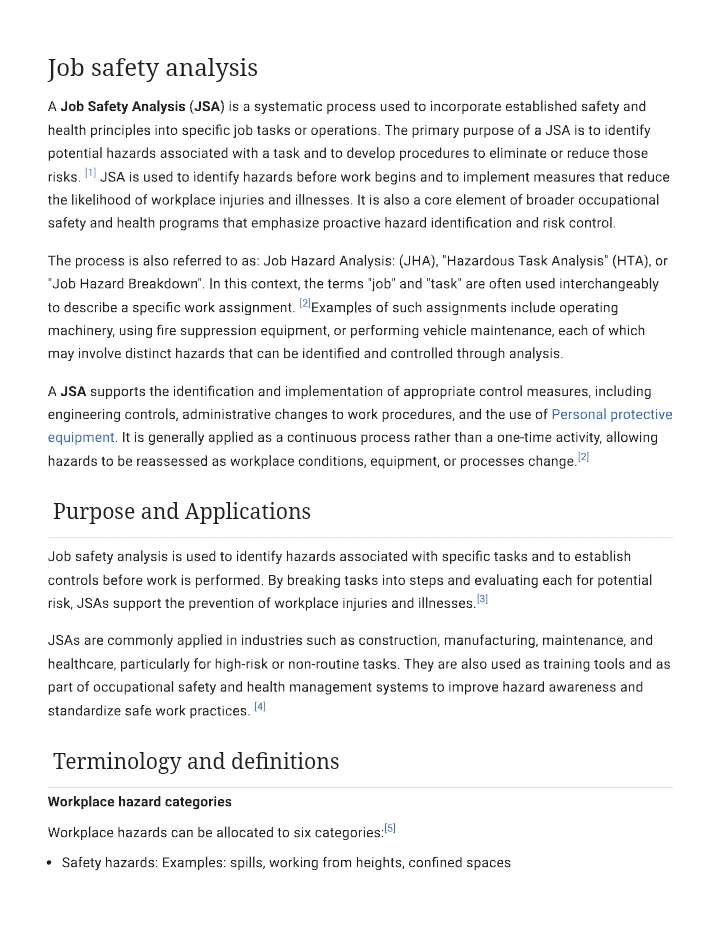
Job safety analysis A Job Safety Analysis ( JSA ) is a systematic process used to incorporate established safety and health principles into speci fi c job tasks or operations. The primary purpose of a JSA is to identify potential hazards associated with a task and to develop procedures to eliminate or reduce those risks. [1] JSA is used to identify hazards before work begins and to implement measures that reduce the likelihood of workplace injuries and illnesses. It is also a core element of broader occupational safety and health programs that emphasize proactive hazard identi fi cation and risk control. The process is also referred to as: Job Hazard Analysis: (JHA), "Hazardous Task Analysis" (HTA), or "Job Hazard Breakdown". In this context, the terms "job" and "task" are often used interchangeably to describe a speci fi c work assignment. [2] Examples of such assignments include operating machinery, using fi re suppression equipment, or performing vehicle maintenance, each of which may involve distinct hazards that can be identi fi ed and controlled through analysis. A JSA supports the identi fi cation and implementation of appropriate control measures, including engineering …