Tunnel Gas Leakage Management – Emergency Preparedness & Safe Evacuation
PowerPoint · 16 slides · English · Construction Safety
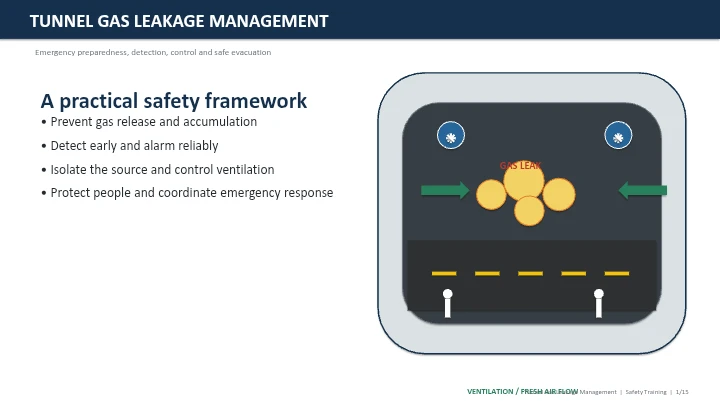
A 15-slide safety training presentation covering tunnel gas leakage hazards, gas detection, ventilation, emergency response, evacuation, isolation, rescue and prevention.
By Awadhesh Shah – Safe Tech Unlimited F S Academy of Excellence · Published 2026-09-30 · Updated 2026-11-15
From the document
TUNNEL GAS LEAKAGE MANAGEMENT Emergency preparedness, detection, control and safe evacuation GAS LEAK VENTILATION / FRESH AIR FLOW A practical safety framework • Prevent gas release and accumulation • Detect early and alarm reliably • Isolate the source and control ventilation • Protect people and coordinate emergency response Tunnel Gas Leakage Management | Safety Training | 1/15 1. GAS LEAKAGE HAZARDS • Toxicity: inhalation can cause acute or delayed injury • Flammability: gas-air mixtures may ignite or explode • Asphyxiation: oxygen displacement can cause collapse • Poor visibility and panic can complicate evacuation • Confined geometry can allow rapid accumulation and migration GAS LEAK VENTILATION / FRESH AIR FLOW Tunnel Gas Leakage Management | Safety Training | 2/15 Tunnel Gas Management Presented by F S Academy of Excellence- DGFASLI approved Safety Institute AWADHESH SHAH SAFE TECH UNLIMTED 2. TYPICAL SOURCES OF GAS RELEASE • Fuel / process gas pipelines, valves and flanges • Welding, cutting and hot-work operations • Chemical storage, transfer and dosing systems • Vehicle exhaust or combustion gases • Battery charging, sewage or biological decomposition areas • Damage to …
tunnel gas leakage · gas leak · gas safety · emergency response · tunnel safety · gas detection · gas monitoring · ventilation safety · h2s · co
Read Tunnel Gas Leakage Management – Emergency Preparedness & Safe Evacuation online
- Hierarchy of Control – Snake Hazard at Construction Site
An 80-second bilingual safety awareness video demonstrating the Hierarchy of Controls through a snake-hazard scenario at a construction site. The video explains elimination, subst…
- Sling Angle Rule - Load Capacity vs Angle Chart
Sling angle aur lifting capacity ke beech relation samjhata hai — 90° se 30° se kam angle tak load-per-leg % aur efficiency loss, plus chhota angle hone par failure ka risk chain.
- WORK AT HEIGHT TRAINING
A 36-page Work at Height Training presentation covering work-at-height hazards, fall prevention, ladders, scaffolding, safe working practices, fall protection, scaffold tagging, t…
- Behaviour Based Safety – Developing a Safety Culture
A practical presentation explaining Behaviour Based Safety, its history, successful program elements, observation process, criticisms, future applications and available technology.
- Mobile Crane Lifting – Lifting Tools, Tackles & Safe Crane Operations
A 46-page visual safety handbook covering mobile crane lifting, lifting tools and tackles, slings, crane components, inspection requirements, lifting plans, crane safety devices,…
- Risk-Reduction Methods for Occupational Safety and Health
A comprehensive occupational safety and health reference covering hazard identification, risk assessment, job hazard analysis, incident investigation, human error reduction, risk-…
- IS 11057:1984 – Specification for Industrial Safety Nets | First Revision with Amendment No. 1
Indian Standard IS 11057:1984 specifies requirements for industrial safety nets made from man-made fibres and intended to protect personnel and/or debris from falling during work…
- Safe Use of Safety Nets – Best Practice Guidelines
A practical safety guideline covering the selection, design, installation, inspection, testing, maintenance, and safe use of safety nets for fall protection during work at height.…
