


Every workplace, whether a factory floor, a construction site, an office, or a mine, carries the potential to affect the physical and mental well-being of the people who work there. Occupational Health is the branch of EHS practice dedicated to identifying, preventing, and managing these health effects before they turn into chronic illness, disability, or worse. For Safety Officers, EHS Professionals, HR Managers, and Factory Managers, understanding occupational health is not just a legal requirement under the Occupational Safety, Health and Working Conditions (OSH&WC) Code, 2020 — it is a core responsibility towards the workforce that keeps operations running. This guide from THE EHS GURU explains what occupational health means, how it differs from occupational safety, and what the law in India requires of employers and employees alike.
What is Occupational Health?
Occupational Health is defined by the World Health Organization (WHO) and the International Labour Organization (ILO) as a field of activity concerned with the promotion and maintenance of the highest degree of physical, mental, and social well-being of workers in all occupations. It focuses on the prevention of health impairments caused by working conditions, the protection of workers from risks arising out of factors adverse to health, and the adaptation of work to the worker, and of each worker to their job.
In simple terms, occupational health looks at how work affects a person’s health — including exposure to chemicals, noise, dust, ergonomic strain, stress, and infectious agents — and how to manage those exposures so that people can work throughout their careers without long-term harm.
According to the ILO/WHO Joint Committee on Occupational Health (1950, revised 1995), occupational health aims at “the promotion and maintenance of the highest degree of physical, mental, and social well-being of workers in all occupations.”
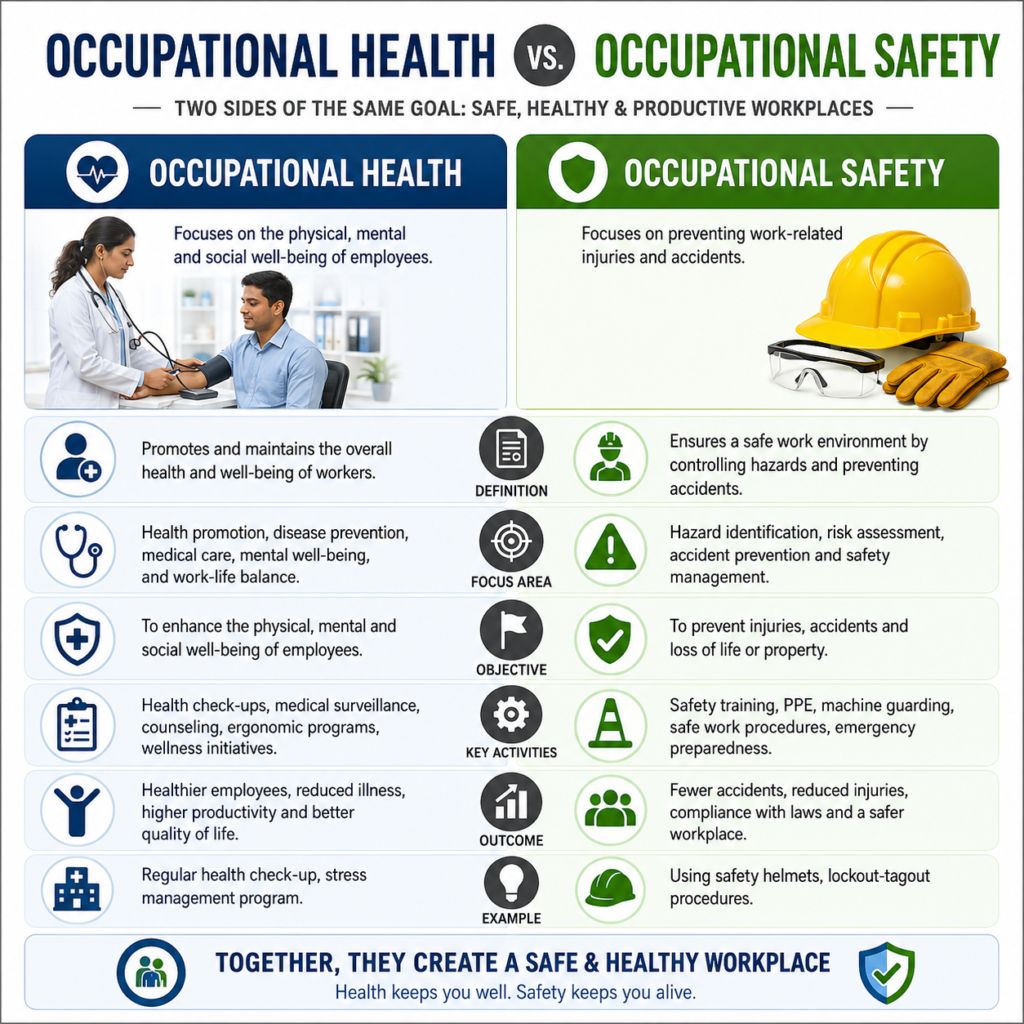
Difference Between Occupational Health and Occupational Safety
The terms “occupational health” and “occupational safety” are often used together — and rightly so, since they are closely linked — but they are not the same thing. Confusing the two can lead to gaps in a workplace risk management programme.
| Aspect | Occupational Health | Occupational Safety |
|---|---|---|
| Primary Focus | Prevention and management of health effects from work exposures (physical, chemical, biological, ergonomic, psychosocial) | Prevention of accidents, injuries, and unsafe conditions/acts |
| Nature of Harm Addressed | Gradual, cumulative, or long-latency illness (e.g., hearing loss, respiratory disease, musculoskeletal disorders) | Sudden, immediate incidents (e.g., falls, machine entanglement, fire) |
| Key Tools | Medical surveillance, health risk assessment, occupational hygiene monitoring, health check-ups | Hazard identification, risk assessment, permit-to-work, safety audits, PPE |
| Typical Professionals Involved | Occupational health physicians, occupational hygienists, nurses | Safety officers, safety engineers, fire officers |
| Regulatory Reference in India | OSH&WC Code, 2020 — health surveillance and welfare provisions | OSH&WC Code, 2020 — safety provisions and safety committees |
| Example Measure | Annual audiometry testing for workers exposed to noise | Machine guarding to prevent entanglement injury |
In practice, a mature EHS management system integrates both — safety controls prevent the accident, while health surveillance catches the slow, silent damage that safety controls alone cannot.
Importance of Occupational Health
- Protects Long-Term Worker Well-Being: Prevents chronic, irreversible conditions such as silicosis, noise-induced hearing loss, and repetitive strain injuries.
- Reduces Absenteeism and Attrition: Healthy workers take fewer sick days and stay longer with an employer.
- Improves Productivity: Workers free from pain, fatigue, or illness perform better and make fewer errors.
- Legal Compliance: Avoids penalties, litigation, and compensation claims under the OSH&WC Code, 2020 and the Code on Social Security, 2020.
- Reputation and Business Continuity: Organizations with strong occupational health records are preferred by clients, investors, and skilled talent.
- Reduces Overall Healthcare and Compensation Costs: Early detection and prevention are far cheaper than treatment, disability payouts, or litigation.
Objectives of Occupational Health
The ILO/WHO Joint Committee identifies three core objectives that remain the foundation of occupational health practice worldwide:
- The maintenance and promotion of workers’ health and working capacity.
- The improvement of the working environment and work to become conducive to safety and health.
- The development of work organizations and working cultures in a direction that supports health and safety at work, promoting a positive social climate and smooth operation.
In a practical workplace setting, these translate into specific, measurable objectives:
- Identifying health hazards through job/task-based risk assessments.
- Conducting pre-employment, periodic, and exit medical examinations.
- Monitoring the workplace environment (noise, dust, fumes, temperature, lighting).
- Managing occupational diseases through early detection and referral.
- Rehabilitating and reintegrating workers who develop work-related health conditions.
- Building a culture of health awareness among the workforce.
Occupational Health in India
India’s approach to occupational health has historically been shaped by sector-specific laws — the Factories Act, 1948, the Mines Act, 1952, the Plantations Labour Act, 1951, and the Dock Workers (Safety, Health and Welfare) Act, 1986 — each of which contained its own health-related provisions, such as requirements for medical examinations, canteens, drinking water, and first aid.
Institutions supporting occupational health in India include:
- DGFASLI (Directorate General Factory Advice Service and Labour Institutes): The technical arm of the Ministry of Labour & Employment advising on safety, health, and working conditions in factories and docks, and conducting research and training through institutes such as CLI (Mumbai) and RLIs.
- DGMS (Directorate General of Mines Safety): Regulates occupational health and safety specifically in the mining sector, including provisions for periodic medical examination of mineworkers.
- ESIC (Employees’ State Insurance Corporation): Provides medical care and cash benefits to workers and their families in the event of sickness, disability, or occupational injury/disease.
- NIOH (National Institute of Occupational Health), ICMR: Conducts research on occupational diseases and exposure limits relevant to Indian industry.
- BIS (Bureau of Indian Standards): Publishes standards relevant to occupational health, such as permissible exposure limits, PPE specifications, and ventilation norms.
With the enactment of the OSH&WC Code, 2020, these fragmented sector-specific provisions are being consolidated into a single framework, though the technical guidance from DGFASLI, DGMS, and BIS standards continues to inform actual implementation.
Occupational Health under the OSH&WC Code, 2020
The OSH&WC Code, 2020, brings together health-related provisions previously scattered across 13 different laws. Key occupational health provisions under the Code include:
- Annual Health Check-ups: The Code enables the appropriate government to notify a requirement for free annual health check-ups for employees above a specified age, in notified establishments, at the employer’s cost.
- Duties of Employer Towards Health: Employers are required to ensure that the workplace is free from hazards that could cause injury or occupational disease, so far as is reasonably practicable.
- Welfare Facilities: Provision of drinking water, canteens, crèches, first-aid, washing facilities, and rest rooms, depending on the establishment and workforce size.
- Working Hours and Rest Intervals: Standardised daily/weekly working hour limits and rest intervals to reduce fatigue-related health risks.
- Occupational Safety and Health Advisory Boards: National and State-level Boards are constituted to advise the government on standards, including occupational health matters.
- Provisions for Hazardous Processes: Special provisions apply to factories carrying out hazardous processes, including compulsory disclosure of hazards to workers and the local community, and medical surveillance of exposed workers.
- Safety Committees: Establishments notified by the appropriate government must constitute Safety Committees with worker representation to address safety and health concerns.
Important Note: The precise age threshold, frequency, and format of health check-ups, along with detailed medical examination requirements, are prescribed through Central and State Rules under the Code, and compliance teams should verify current applicable thresholds from official notifications.
Employer Responsibilities
| Responsibility Area | What It Involves |
|---|---|
| Health Risk Assessment | Identify chemical, physical, biological, and ergonomic hazards specific to each job role and process. |
| Medical Examinations | Arrange pre-employment, periodic, and (where applicable) exit medical examinations, especially for workers exposed to hazardous substances or processes. |
| Occupational Health Centre / First Aid | Set up or arrange access to an Occupational Health Centre or first-aid facility proportionate to workforce size and risk profile. |
| Exposure Monitoring | Monitor noise, dust, fumes, gases, temperature, and lighting levels against permissible exposure limits (BIS/statutory standards). |
| Personal Protective Equipment (PPE) | Provide, and ensure correct use of, PPE suited to identified health hazards. |
| Training and Awareness | Educate workers on health hazards specific to their tasks and safe work practices to minimise exposure. |
| Record-Keeping | Maintain health records, exposure monitoring data, and medical examination reports as prescribed. |
| Reporting Occupational Diseases | Report notifiable occupational diseases to the appropriate authority as required under the Code and Rules. |
Employee Responsibilities
- Attend scheduled medical examinations and health check-ups as required by the employer.
- Use provided PPE correctly and consistently in hazard-prone areas.
- Report symptoms of ill health, discomfort, or suspected work-related illness promptly to supervisors or the Occupational Health Centre.
- Follow safe work practices and standard operating procedures relevant to health hazards (e.g., handling chemicals, working in noisy or dusty areas).
- Participate actively in health and safety training programmes.
- Cooperate with health surveillance programmes, including providing accurate health history where relevant.
- Avoid practices that could increase personal or co-worker exposure to health hazards (e.g., bypassing ventilation systems, removing PPE unnecessarily).
Role of Occupational Health Centres (OHC)
An Occupational Health Centre (OHC) is a dedicated facility — in-house or through an approved external provider — responsible for delivering health services to the workforce of an establishment. Its role typically includes:
- Conducting pre-employment and periodic medical examinations.
- Providing first aid and emergency medical response for workplace injuries or acute illness.
- Monitoring and recording occupational exposure and health surveillance data.
- Advising management on fitness-for-duty, work restrictions, and return-to-work planning after illness or injury.
- Conducting health education and awareness sessions for the workforce.
- Coordinating with statutory bodies such as ESIC for referral and treatment of covered employees.
- Maintaining confidential employee health records in compliance with applicable data protection norms.
For larger factories, mines, and hazardous process units, an OHC staffed by a qualified occupational health physician and nursing staff is generally expected; smaller establishments may rely on a tie-up with a nearby hospital or clinic along with a trained first-aider on site, depending on applicable rules and risk classification.
Occupational Health Policies
A written Occupational Health Policy signals management commitment and provides a framework for consistent implementation. A sound policy typically covers:
- Scope and Commitment: A statement of the organisation’s commitment to protecting employee health, signed by top management.
- Health Risk Management Process: How health hazards are identified, assessed, and controlled across all job roles.
- Medical Surveillance Programme: Frequency and type of medical examinations for different exposure categories.
- Roles and Responsibilities: Clear division of responsibility between management, safety officers, occupational health staff, and employees.
- Emergency Medical Response: Procedures for handling workplace medical emergencies.
- Confidentiality of Health Records: How employee health data is stored, accessed, and protected.
- Continuous Improvement: Periodic review of the policy based on incident trends, audit findings, and regulatory changes.
Key Takeaway: A policy that exists only on paper adds little value — its effectiveness depends on visible implementation, periodic audits, and genuine leadership engagement.
Workplace Health Promotion
Beyond preventing occupational illness, many organizations now invest in broader workplace health promotion to improve overall employee well-being. This goes beyond legal minimums and includes:
- Health education sessions on nutrition, hydration, and lifestyle diseases (diabetes, hypertension, obesity).
- Ergonomic assessments for office and non-industrial workstations to prevent musculoskeletal disorders.
- Mental health support, including stress management programmes and access to counselling.
- Fitness initiatives such as on-site gyms, yoga sessions, or wellness challenges.
- Smoking cessation and substance abuse awareness programmes.
- Regular health camps in partnership with local hospitals or government health schemes.
- Vaccination drives (e.g., seasonal influenza, or as relevant to the region and occupation).
Workplace health promotion, while not always mandated by law, has a measurable impact on absenteeism, morale, and long-term healthcare costs — making it a sound business investment as well as a legal and ethical good practice.
Practical Examples
Example 1: Noise-Induced Hearing Loss in a Textile Mill
Workers on a weaving floor are exposed to continuous noise levels exceeding permissible limits. An effective occupational health programme would include periodic audiometry testing, provision of hearing protection, engineering controls to reduce noise at source, and job rotation to limit exposure duration — preventing the gradual, irreversible hearing loss that would otherwise go unnoticed until severe.
Example 2: Respiratory Illness in a Foundry
Workers exposed to silica dust in a foundry are at risk of silicosis, a serious and irreversible lung disease. Occupational health measures here include dust suppression systems, respiratory protective equipment, periodic chest X-rays/lung function tests, and health records tracking cumulative exposure over years of employment.
Example 3: Musculoskeletal Disorders in an Office Environment
Employees working long hours at poorly designed workstations may develop back pain or repetitive strain injury. A workplace health promotion initiative — ergonomic workstation assessments, ergonomic chairs, and regular stretch breaks — addresses this before it becomes a chronic, disabling condition.
Key Takeaways
- Occupational health focuses on preventing gradual, work-related illness — distinct from, but complementary to, occupational safety, which prevents accidents.
- The OSH&WC Code, 2020, consolidates health-related provisions previously spread across 13 laws, including health check-ups, welfare facilities, and hazardous process disclosures.
- Employers must proactively identify health hazards, arrange medical surveillance, and maintain occupational health records.
- Employees share responsibility through cooperation with medical examinations, correct PPE use, and prompt reporting of symptoms.
- Occupational Health Centres and written health policies form the operational backbone of a workplace health programme.
- Workplace health promotion — going beyond legal minimums — delivers measurable business and human benefits.
Conclusion
Occupational health is not a checkbox exercise confined to an annual medical camp — it is a continuous, systematic effort to protect workers from the slow, cumulative harms that work can cause, whether from noise, dust, chemicals, ergonomic strain, or psychosocial stress. With the OSH&WC Code, 2020, India has consolidated decades of sector-specific health provisions into a single, more coherent legal framework, but the responsibility for genuine implementation rests with employers, safety officers, and EHS teams on the ground. A workplace that invests in occupational health — through risk assessment, medical surveillance, a properly functioning Occupational Health Centre, and a culture of health awareness — protects not only its legal standing but its most valuable asset: its people. For every Safety Officer, HR Manager, and Factory Manager, occupational health should sit at the very centre of workplace risk management, not at its periphery.
Explore More on THE EHS GURU
Occupational health is just one pillar of a complete workplace safety and compliance strategy. Explore more in-depth guides on Occupational Safety, the OSH&WC Code, 2020, Factory Compliance, and Workplace Risk Management on THE EHS GURU to build a stronger, safer, and healthier workplace for your organization.
Frequently Asked Questions (FAQs)
1. What is occupational health in simple terms?
Occupational health is the practice of protecting workers’ physical and mental well-being from harm caused by their work environment, tasks, or exposures.
2. What is the difference between occupational health and occupational safety?
Occupational health deals with preventing gradual, work-related illness (e.g., hearing loss, respiratory disease), while occupational safety deals with preventing sudden accidents and injuries.
3. Which law governs occupational health in India?
The Occupational Safety, Health and Working Conditions (OSH&WC) Code, 2020, is the primary consolidated law governing occupational health in India, alongside supporting technical guidance from DGFASLI, DGMS, and BIS standards.
4. What are the three main objectives of occupational health as per ILO/WHO?
Maintaining and promoting workers’ health and working capacity; improving the working environment to be conducive to health and safety; and developing work organisation and culture to support health at work.
5. What is an Occupational Health Centre (OHC)?
An OHC is a dedicated facility, in-house or outsourced, that provides medical examinations, first aid, health surveillance, and health advisory services to an organisation’s workforce.
6. Is an annual health check-up mandatory for all employees under the OSH&WC Code?
The Code enables the appropriate government to notify mandatory free annual health check-ups for employees above a specified age in notified establishments; exact thresholds should be verified from applicable Central/State Rules.
7. What is the role of DGFASLI in occupational health?
DGFASLI is the technical advisory body under the Ministry of Labour & Employment that advises on occupational safety and health standards in factories and docks, and conducts related research and training.
8. What is the role of DGMS in occupational health?
The Directorate General of Mines Safety regulates occupational safety and health specifically for the mining sector, including periodic medical examinations of mineworkers.
9. What are common occupational diseases in Indian industries?
Common examples include noise-induced hearing loss, silicosis and other pneumoconiosis in mining/foundry work, musculoskeletal disorders, occupational dermatitis, and chemical poisoning in certain process industries.
10. What is medical surveillance in occupational health?
Medical surveillance refers to systematic, periodic health monitoring of workers exposed to specific hazards, aimed at early detection of adverse health effects.
11. Who is responsible for occupational health in a workplace?
Primary responsibility lies with the employer, supported by safety officers, occupational health physicians/nurses, and with active cooperation from employees.
12. Does occupational health cover mental health?
Yes, the WHO/ILO definition of occupational health explicitly includes mental and social well-being, alongside physical health, and increasingly this includes workplace stress and psychosocial risk factors.
13. What welfare facilities are required for employee health under the OSH&WC Code?
Depending on establishment size and sector, facilities such as drinking water, canteens, crèches, washing facilities, rest rooms, and first aid are required under the Code.
14. What is the difference between a first-aid box and an Occupational Health Centre?
A first-aid box provides basic emergency treatment for minor injuries, while an OHC is a more comprehensive facility offering medical examinations, health surveillance, and professional medical care.
15. What is workplace health promotion?
Workplace health promotion refers to voluntary initiatives beyond legal minimums — such as fitness programmes, nutrition education, and mental health support — aimed at improving overall employee well-being.
16. Are employers required to report occupational diseases?
Yes, notifiable occupational diseases must be reported to the appropriate authority as prescribed under the OSH&WC Code and applicable Rules.
17. How does ESIC support occupational health in India?
The Employees’ State Insurance Corporation provides medical treatment and cash benefits to insured employees and their dependents in cases of sickness, disability, or occupational injury/disease.
18. What BIS standards are relevant to occupational health?
BIS publishes standards covering areas such as permissible exposure limits for chemicals, PPE specifications, ventilation, and lighting norms relevant to protecting worker health.
19. Can small establishments be exempt from occupational health requirements?
Certain provisions under the OSH&WC Code and its Rules apply based on establishment size, sector, and risk classification; smaller establishments may have reduced but not entirely eliminated obligations, particularly around first aid and basic welfare facilities.
20. Why is occupational health important for business, not just compliance?
Beyond legal compliance, strong occupational health practices reduce absenteeism, improve productivity, lower compensation and healthcare costs, and strengthen the organisation’s reputation as a responsible employer.
Official References
- World Health Organization (WHO) — Occupational Health publications
- International Labour Organization (ILO) — ILO/WHO Joint Committee on Occupational Health definitions and conventions
- Ministry of Labour & Employment, Government of India — labour.gov.in
- The Occupational Safety, Health and Working Conditions Code, 2020 — Gazette Notification
- Directorate General Factory Advice Service and Labour Institutes (DGFASLI)
- Directorate General of Mines Safety (DGMS)
- Bureau of Indian Standards (BIS)
- Employees’ State Insurance Corporation (ESIC)
- National Institute of Occupational Health (NIOH), Indian Council of Medical Research


Thank you for sharing such kind of informative Knowledge…..