


The Occupational Safety, Health and Working Conditions Code, 2020 (OSHWC Code, Act No. 37 of 2020) is one of the four labour codes through which India has consolidated its sprawling web of central labour legislation. For decades, workplace safety, health and welfare in India were governed by thirteen separate enactments — the Factories Act, 1948, the Mines Act, 1952, the Contract Labour (Regulation and Abolition) Act, 1970, the Building and Other Construction Workers Act, 1996, and ten others — each with its own definitions, registers, forms and enforcement machinery. For an employer running operations across states, or even across different types of establishments in the same state, this meant tracking thirteen sets of obligations simultaneously.
The OSHWC Code brings all of this under one statute. It does not merely renumber old provisions; it re-engineers the compliance architecture itself — a single registration instead of six, a single licence instead of four, twenty forms instead of fifty-five, and one annual return instead of twenty-one. This article walks through the Code in detail: its background, applicability, core obligations, special worker categories, licensing and inspection machinery, penalties, and the practical forms and registers establishments must maintain, so that HR, EHS and compliance teams have a single reference point for the law as it stands today.
Background and Legislative History
Understanding why the Code looks the way it does requires understanding the compliance environment it was built to fix. Under the previous regime, an employer running, say, a factory with an in-house construction project and a contingent of contract labour could simultaneously owe registrations under the Factories Act, the Contract Labour Act and the Building and Other Construction Workers Act — each with its own form numbers, its own inspecting authority, and its own return-filing calendar. Multiply this across States, each of which could layer on its own procedural rules, and the result was a compliance burden that fell hardest on smaller employers least equipped to manage it, while doing relatively little to improve actual safety outcomes on the ground.
The push to simplify India’s labour laws goes back to the Second National Commission on Labour (2002), which recommended that the country’s numerous central labour statutes be consolidated into four broad codes covering wages, industrial relations, social security, and occupational safety, health and working conditions. Acting on this, the government first introduced the Occupational Safety, Health and Working Conditions Code as a Bill in 2019. After review by the Parliamentary Standing Committee on Labour, and further changes prompted by the experience of the COVID-19 pandemic, the revised Code was passed as the Occupational Safety, Health and Working Conditions Code, 2020, receiving assent on 28th September 2020 as Act No. 37 of 2020.
The Code repeals and replaces thirteen earlier laws, including the Factories Act, 1948; the Plantations Labour Act, 1951; the Mines Act, 1952; the Contract Labour (Regulation and Abolition) Act, 1970; the Inter-State Migrant Workmen Act, 1979; the Building and Other Construction Workers Act, 1996; and the Dock Workers (Safety, Health and Welfare) Act, 1986, among others. Rather than being brought into force all at once, the Code’s various provisions have been notified in phases, with the appropriate Central and State Rules following at each stage — most recently, the draft Central Rules under Sections 133 and 134 of the Code have been published for stakeholder comment as part of finalising the compliance machinery.
Objectives of the Code
The OSHWC Code is built around a small number of clearly stated goals:
- Bring uniformity to safety, health and working-condition standards across industries and States/UTs by replacing a patchwork of thirteen Acts with one.
- Widen coverage so that occupational safety and health protections extend to establishments and worker categories that earlier laws left out — such as journalists in digital and electronic media, and audio-visual and stunt workers.
- Reduce compliance burden through single registration, single licensing, electronic filing and time-bound (deemed) approvals.
- Modernise enforcement by replacing the traditional “Inspector” with an “Inspector-cum-Facilitator” who is expected to guide compliance rather than merely police it, supported by randomised, web-based inspection scheduling.
- Strengthen worker welfare through mandatory appointment letters, free annual health check-ups, safety committees, and portability of benefits for inter-State migrant workers.
- Introduce proportionate, less punitive enforcement through compounding of offences and a mandatory improvement-notice period before prosecution for many contraventions.
Scope and Applicability
The Code applies to a wide sweep of establishments, but the applicability threshold varies depending on the type of establishment and the specific chapter in question. As a general rule:
- Any place where an industry, trade, business, manufacturing or occupation is carried on and ten or more workers are employed is an “establishment” for the purposes of registration under Chapter II.
- Motor transport undertakings, newspaper establishments, audio-visual production units, building or other construction work, and plantations are covered once ten or more workers are employed.
- Factories are covered once twenty or more workers are employed with the aid of power, or forty or more without the aid of power — though for the limited purpose of registration under Chapter II, the ten-worker threshold applies.
- Mines, ports, and areas where dock work is carried out are establishments regardless of numerical threshold.
- Where the establishment carries on a hazardous or life-threatening activity notified by the Central Government, the worker-count threshold does not apply at all — even a single-employee hazardous operation can be brought within scope.
The Code does not apply to offices of the Central or State Government, or to any ship of war of any nationality — except that contract labour engaged through a contractor in government offices remains covered where the Government itself is the principal employer.
Important Definitions
Before getting into obligations, it helps to fix a shared vocabulary, because several terms in the Code carry a technical meaning that differs from everyday usage — and compliance teams frequently misapply obligations by treating “worker,” “employee” and “contract labour” as interchangeable when the Code deliberately does not.
The Code’s definitions clause is unusually long, but a handful of terms recur throughout and are worth understanding upfront:
| Term | Meaning (in brief) |
|---|---|
| Appropriate Government | Central Government for establishments it controls directly (railways, mines, oilfields, major ports, banking, insurance, PSUs, etc.); State Government for factories, motor transport undertakings, plantations, newspaper establishments and beedi/cigar establishments situated in that State. |
| Worker | Any person doing manual, unskilled, skilled, technical, operational, clerical or supervisory work for hire or reward — excluding those in purely managerial/administrative roles, or supervisors drawing wages above the notified threshold (currently referenced at ₹18,000 per month). |
| Employee | A broader term than “worker” — covers anyone employed on wages to do any kind of work, including managerial and administrative staff, but excludes members of the Armed Forces. |
| Contract Labour | A worker hired in connection with the work of an establishment by or through a contractor, with or without the principal employer’s knowledge; includes inter-State migrant workers. |
| Inter-State Migrant Worker | A person recruited in one State for employment in an establishment in another State (directly or through a contractor), or who migrates on their own and takes up employment in the destination State, drawing wages up to the notified ceiling. |
| Hazardous Process | Any process listed in the First Schedule, or notified as such, where raw materials, intermediates, effluents or emissions could impair worker health or pollute the environment unless special precautions are taken. |
| Core Activity | Any activity for which an establishment is set up, and anything essential to it — but excluding a defined list of “support” functions (sanitation, security, canteen, loading/unloading, gardening, transport, etc.) which are treated as non-core even if performed continuously. |
| Establishment | A place where an industry, trade, business, manufacturing or occupation is carried on with ten or more workers; also covers motor transport undertakings, newspaper establishments, audio-visual production units, building/construction work and plantations at the same threshold, and mines/ports/dock-work areas irrespective of worker count. |
| Occupier (of a factory) | The person with ultimate control over the affairs of the factory — a partner in a firm, a director in a company (excluding independent directors), or the person appointed to manage a government-owned factory. |
| Principal Employer | The person responsible for supervision and control of an establishment where contract labour is engaged — the owner/occupier in a factory, the owner/agent in a mine, or the head of office in a government establishment. |
| Building or Other Construction Work | Construction, alteration, repair, maintenance or demolition of buildings, roads, bridges, dams, canals, power and communication infrastructure and similar works — excluding factory/mine-related construction and small individual residential work below a notified cost and worker-count threshold. |
Key Features of the OSHWC Code
The consolidation achieved by the Code is best illustrated numerically. The table below (as summarised by the Ministry of Labour & Employment) compares the pre-Code position with the position under the OSHWC Code:
| Subject | Existing (13) Laws | OSHWC Code, 2020 |
|---|---|---|
| Number of Acts | 13 | 1 |
| Sections | 620 | 143 |
| Rules | 868 | 175 |
| Registrations | 6 | 1 |
| Licences | 4 | 1 |
| Forms | 55 | 20 (Central Rules currently prescribe 27) |
| Returns | 21 | 1 |
| Compounding of offences | No provision | New provision |
| Improvement Notice | No provision | New provision |
Beyond the numerical simplification, several substantive changes stand out: mandatory appointment letters for every employee; free annual health check-ups for employees above a notified age; a National and State-level Occupational Safety and Health Advisory Board; a Social Security Fund for unorganised workers funded through compounding and penalty receipts; and a general shift from criminal prosecution towards civil penalties and compounding for many first-time or procedural lapses.
Duties of the Employer
Section 6 casts a broad, affirmative duty on every employer to keep the workplace free of hazards likely to cause injury or disease, and to comply with occupational safety and health standards declared under the Code. In practical terms, this translates into a checklist of recurring obligations:
- Provide and maintain a safe working environment, plant and systems of work.
- Issue a written letter of appointment to every employee, in the prescribed form, within three months for those already in service when the Code commenced.
- Provide free annual health examinations to employees of the prescribed age or class.
- Ensure safe disposal of hazardous and toxic waste, including e-waste.
- Never charge employees for anything provided towards their own safety, health or medical examination.
- Provide information, instruction, training and supervision necessary for employee safety.
- Maintain safe means of access to and egress from every workplace.
Designers, manufacturers, importers and suppliers of articles used in an establishment carry parallel duties — to ensure the article is safe when properly used, to test it, and to make safety information available to users. Architects, project engineers and designers of buildings and construction projects must likewise build safety into the design stage itself, not retrofit it later.
Duties and Rights of Employees
Employees are not passive beneficiaries under the Code — Section 13 requires every employee to take reasonable care for their own safety and that of others, comply with safety standards, cooperate with the employer’s statutory obligations, and promptly report unsafe conditions. Employees must not wilfully misuse or interfere with any safety appliance provided at the workplace.
In return, Section 14 gives every employee the right to obtain safety and health information from the employer, to raise safety concerns through a Safety Committee (where constituted) or directly with the Inspector-cum-Facilitator, and — critically — the right to flag imminent danger to health or life and expect immediate remedial action.
Occupational Safety and Health Framework
Chapter IV establishes the institutional backbone for occupational safety and health policy: a tripartite National Occupational Safety and Health Advisory Board chaired by the Secretary, Ministry of Labour and Employment, with representation from Directors-General of Factory Advice Service, Mines Safety, Explosives, Pollution Control, employers, employees, and independent experts. A parallel State Occupational Safety and Health Advisory Board performs a similar advisory function at State level.
The Central Government declares binding occupational safety and health standards under Section 18, covering physical, chemical and biological hazards, exposure monitoring, medical examination protocols, and hazard-evaluation techniques such as safety audits and hazard-and-operability studies. Establishments meeting the notified thresholds must also constitute a Safety Committee and appoint safety officers — mandatory for factories with 500+ workers, hazardous-process factories with 250+ workers, building/construction sites with 250+ workers, and mines with 100+ workers.
Health Provisions
Section 23 obliges employers to maintain prescribed standards of cleanliness, ventilation, temperature and humidity control, dust and fume control, potable drinking water, adequate lighting, and separate latrine/urinal facilities for male, female and transgender employees. These are baseline conditions applicable regardless of industry, reflecting the Code’s shift towards universal health protection rather than sector-specific rules.
Welfare Provisions
Chapter VI requires washing and bathing facilities (separated by gender), locker rooms, sitting arrangements for standing workers, canteens (where 100+ workers including contract labour are employed), first-aid boxes, and — for larger establishments — ambulance rooms, rest rooms, and a welfare officer where 250 or more workers are ordinarily employed in a factory, mine or plantation. A notable modernisation is the creche requirement: establishments with more than 50 workers must provide creche facilities for children under six, and — unlike the position under the old Factories Act — this benefit is now gender-neutral, available regardless of whether the parent is male or female.
Working Hours, Weekly Holidays and Overtime
No worker may be required to work more than eight hours a day, with intervals and spread-over fixed by the appropriate Government. Workers may not be engaged for more than six days a week without a compensatory holiday. Where a worker is asked to work overtime, this requires the worker’s consent, and overtime must be paid at twice the ordinary wage rate. The Code gives the appropriate Government flexibility to fix the overtime ceiling — commonly cited implementation guidance allows up to 12 hours a day without triggering overtime in a 4-day week structure, 9.5 hours in a 5-day week, and 8 hours in a 6-day week, subject to the notified quarterly/other period ceiling on total overtime hours (in place of the earlier flat 75-hours-a-quarter limit under the Factories Act).
Special rules apply to mine workers (restrictions on hours below ground), motor transport workers (running time plus subsidiary work counted as working hours), and working journalists (a ceiling of 144 hours over four consecutive weeks with at least 24 consecutive hours of rest in every seven days).
Leave Provisions
Every worker who has worked 180 days or more in a calendar year (reduced from 240 days under the earlier Factories Act) becomes entitled to earned leave — one day for every twenty days worked (fifteen days for adolescents, and for workers employed below ground in mines). Leave can be carried forward up to 30 days, with unlimited carry-forward where leave was applied for but refused by the employer, and encashment is available at year-end for leave in excess of the 30-day cap.
Employment of Women
Section 43 is a significant liberalisation: women may now be employed in all establishments for all types of work, and — with their consent — before 6 a.m. and after 7 p.m., subject to safety, holiday and working-hour conditions prescribed by the appropriate Government. Where a particular hazardous operation is considered unsafe for women, the appropriate Government can direct the employer to put additional safeguards in place before employing women in that operation, rather than barring their employment outright.
Contract Labour
Part I of Chapter XI governs contract labour, applying to establishments engaging 50 or more contract workers, or contractors who supply 50 or more contract workers (raised from the 20-worker threshold under the old Contract Labour Act). Contractors must hold a licence — either a standard licence or, where they do not meet the full eligibility criteria, a “work specific licence” tied to a particular work order.
The Code prohibits contract labour in an establishment’s “core activities,” subject to three exceptions: where the activity is ordinarily contracted out as normal business practice; where the work does not need full-time workers for a major part of the day; or where there is a sudden, time-bound spike in core-activity volume. Welfare facilities under Sections 23–24 must be extended to contract labour by the principal employer, and if a contractor defaults on wage payment, the principal employer becomes liable to pay and recover the amount from the contractor.
Inter-State Migrant Workers
Part II extends to every establishment employing ten or more inter-State migrant workers. The definition has been widened to cover workers who migrate on their own initiative and find work in the destination State, not only those recruited directly by an employer or contractor. Entitlements include a mandatory annual journey allowance for travel to and from the native place, portability of Public Distribution System (ration) benefits and Building & Other Construction Worker cess-fund benefits between home and destination States, a toll-free helpline, and a self-declaration/Aadhaar-based registration portal.
Factories
Part VII of Chapter XI deals specifically with factories. A “factory” is any premises where 20 or more workers work with the aid of power, or 40 or more without power, in a manufacturing process. Approval and licensing rules cover the submission of building plans, site permission, and licence renewal, with a 30-day deemed-approval mechanism if the authority does not respond in time. Factories carrying on a hazardous process face additional obligations — compulsory public disclosure of hazards, an on-site emergency plan, a site appraisal committee for new hazardous-process factories, and mandatory pre-employment and periodic medical examination of exposed workers.
Mines
Part IV governs mines, requiring every mine to function under a sole qualified manager responsible for overall safety, subject to instructions from the owner/agent. Persons below 18 years of age cannot be employed in a mine (apprentices/trainees aged 16+ may work under supervision with prior approval). The Code retains special exemption provisions for prospecting excavations and minor mineral extraction (kankar, ordinary sand, ordinary clay, etc.), while giving the Central Government power to withdraw these exemptions if conditions change.
Plantations
Part VIII requires plantation employers to provide housing (including drinking water, kitchen and toilet facilities), creche facilities where 50 or more workers are employed, educational facilities where 25 or more children of workers fall in the 6–12 age bracket, health facilities (or ESI coverage — a new option not available to plantations previously), and recreational facilities. Safety provisions specifically address the handling, storage and transport of insecticides, pesticides and toxic chemicals used in plantation operations.
Building and Other Construction Workers
Part VI prohibits the employment of persons with disqualifying conditions — deafness, defective vision, or a tendency to giddiness — in construction operations that could endanger themselves or others given those conditions. Building or other construction work is broadly defined to cover construction, alteration, repair, maintenance or demolition activity across a long list of infrastructure types, while excluding small-scale individual residential construction below a notified cost threshold and worker-count.
Registration of Establishments
Section 3 replaces the earlier requirement of multiple, sector-specific registrations with a single electronic registration, to be applied for within 60 days of the Code becoming applicable to the establishment. If the registering officer fails to act within the prescribed time, the registration is deemed granted automatically. Establishments already registered under another Central labour law or notified law are deemed registered under the Code, provided they furnish their existing registration details. Any change in ownership, management or key particulars must be intimated within 30 days, and closure must be reported within 30 days along with a certificate that all worker dues have been paid.
Licensing
Section 119 introduces the concept of a common licence — a single licence covering a factory, industrial premises for beedi/cigar work, and engagement of contract labour, or any combination of these — valid, in the case of contract labour licences, for five years. Applications are made electronically, and a 45-day deemed-issuance rule applies if the licensing authority does not act in time. Existing licences obtained under earlier Central labour laws are deemed valid under the Code for their remaining term.
Inspector-cum-Facilitator
The Code renames the traditional factory/mine “Inspector” as an “Inspector-cum-Facilitator,” reflecting a deliberate policy shift towards facilitation over policing. Inspections are assigned through a randomised, web-based scheme rather than at an inspector’s discretion, reducing scope for arbitrary or repeated targeting of the same establishment. Inspector-cum-Facilitators retain strong powers — entry, inspection, seizure of documents, sampling, and issuing show-cause notices — but the Code also introduces a Third Party Audit and Certification scheme, under which empanelled experts can certify compliance for notified establishments (particularly start-ups) in place of a departmental inspections.

Safety Officer, Welfare Officer and Safety Committee
As noted above, Safety Committees and safety officers become mandatory once an establishment crosses the relevant worker-count threshold (500 for factories generally, 250 for hazardous-process factories and construction sites, 100 for mines). Separately, a Welfare Officer must be appointed in every factory, mine or plantation employing 250 or more workers. Safety Committees must include worker representation not less than employer representation, giving workers a structured channel to raise safety concerns collectively rather than only individually.
Accident Reporting, Dangerous Occurrences and Occupational Diseases
Section 10 requires notice of any accident causing death, or an injury preventing work for 48 hours or more, to be sent to the prescribed authority within the prescribed time. Section 11 requires notice of “dangerous occurrences” of a prescribed nature, whether or not they cause bodily injury. Section 12 requires notice where a worker contracts any disease listed in the Third Schedule (which includes conditions such as lead poisoning, silicosis, asbestosis, byssinosis, noise-induced hearing loss, and occupational cancer) — and a qualified medical practitioner attending such a worker is independently obliged to report to the Chief Inspector-cum-Facilitator, failing which the practitioner faces a monetary penalty.
Forms, Registers, Notices, Schedules and Returns
One of the Code’s most tangible simplifications is in paperwork. Against 55 forms and 21 returns across the earlier thirteen laws, the OSHWC Code framework (per the draft Central Rules under Sections 133–134) currently prescribes 27 forms covering the entire employment lifecycle — registration, licensing, health examination, accident notice, wage and leave registers, annual returns, and offence composition. Registers have been cut from roughly 84 to just 8, and returns from 21 to effectively a single annual filing. A full form-by-form list appears in the downloads table below.
Offences and Penalties
Chapter XII sets out a graded penalty structure, moving away from automatic imprisonment towards monetary penalties for most contraventions, with imprisonment reserved for repeat or serious violations:
| Offence | Penalty / Punishment |
|---|---|
| General contravention of the Code (Section 94) | ₹2 lakh – ₹3 lakh, plus ₹2,000/day for continuing contravention |
| Obstructing an Inspector-cum-Facilitator (Section 95) | Up to 3 months’ imprisonment or up to ₹1 lakh fine, or both (higher on repeat) |
| Non-maintenance of registers/returns (Section 96) | ₹50,000 – ₹1 lakh |
| Contravention of prohibitory/restrictive orders (Section 97) | ₹50,000 – ₹1 lakh (imprisonment up to 3 months on repeat) |
| Falsification of records (Section 98) | Up to 3 months’ imprisonment or ₹1 lakh fine, or both |
| Hazardous-process duty violations (Section 102) | Up to 2 years’ imprisonment and ₹5 lakh fine, with daily continuing fine |
| Safety violation resulting in death (Section 103) | Up to 2 years’ imprisonment or fine not less than ₹5 lakh, or both; 50%+ of fine payable as victim compensation |
| Safety violation resulting in serious bodily injury (Section 103) | Up to 1 year imprisonment or fine ₹2–4 lakh, or both |
Two structural innovations soften this framework’s harshness for minor or first-time lapses: Section 110 requires the Inspector-cum-Facilitator to give the employer a 30-day “improvement notice” opportunity to correct a violation before prosecuting (except where an accident has occurred, or the same violation recurs within three years); and Section 114 allows many penalties and offences to be compounded — for a fixed percentage of the maximum penalty or fine — closing the matter without further proceedings.
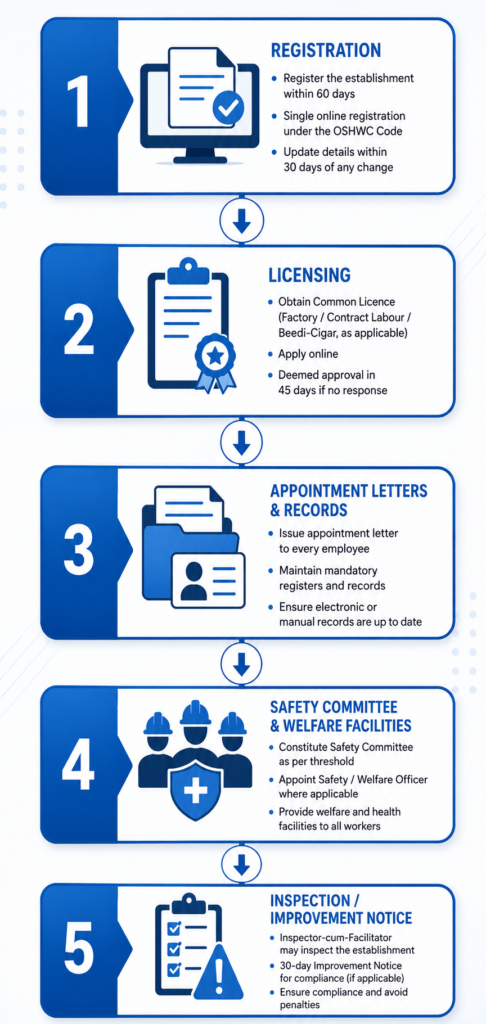
Compliance Checklist
The list below is deliberately organised in the rough sequence an establishment will encounter these obligations — from first setting up, through ongoing operations, to periodic filings — so that HR and EHS teams can use it as a working checklist rather than a static reference.
- Register the establishment electronically within 60 days of the Code becoming applicable, and keep registration particulars updated within 30 days of any change.
- Obtain the appropriate licence(s) — common licence where factory, contract labour and/or beedi-cigar work coincide.
- Issue a written appointment letter to every employee.
- Maintain the prescribed registers (establishment, employee, attendance/muster roll, wages/overtime, leave, accidents/dangerous occurrences) and file the annual return on time.
- Constitute a Safety Committee and appoint safety/welfare officers once the applicable worker-count threshold is crossed.
- Provide free annual health check-ups, first-aid facilities, canteen (100+ workers), creche (50+ workers), and washing/bathing facilities.
- Report accidents, dangerous occurrences and notifiable diseases within the prescribed time frame.
- Pay overtime at double the ordinary rate, only with the worker’s consent, within the notified hours ceiling.
- Extend welfare facilities and timely wage payment to contract labour and inter-State migrant workers.
- Respond to improvement notices within 30 days to avoid prosecution.
Practical Examples
Example 1 — Registration threshold. A garment manufacturing unit engaging 15 workers, none of them using powered machinery, is not yet a “factory” under the 40-worker (without power) threshold, but it must still register under Chapter II once it crosses ten workers.
Example 2 — Contract labour licensing. A company engaging 35 contract workers through a single manpower contractor falls below the 50-worker threshold for Part I of Chapter XI and is therefore outside the licensing requirement for that contractor — though welfare-facility obligations under Sections 23–24 for those workers, where otherwise applicable, still apply through the principal employer.
Example 3 — Overtime consent. A factory asking machine operators to work an additional two hours during a peak production run must obtain the workers’ consent and pay double the normal wage rate for those extra hours; unilaterally extending shifts without consent is itself a contravention, independent of the overtime pay question.
Example 4 — Deemed registration. An establishment applies electronically for registration and the registering officer neither grants nor rejects the application within the prescribed period. Under Section 3(3), the establishment is deemed registered automatically and an electronic certificate is auto-generated — the delay becomes the registering officer’s responsibility, not a compliance gap for the employer.
Example 5 — Improvement notice before prosecution. An Inspector-cum-Facilitator finds that a mid-sized factory has not been maintaining its wage-and-overtime register in the prescribed form. Rather than prosecuting immediately under Section 96, the Inspector-cum-Facilitator must ordinarily issue a 30-day improvement notice under Section 110 first — prosecution follows only if the employer fails to comply within that window, or if the same lapse recurs within three years.
Best Practices for EHS Compliance
- Build a single compliance calendar tracking registration renewal, licence renewal, annual return filing, and periodic medical examination cycles.
- Digitise registers and wage slips from the outset — the Code explicitly permits electronic maintenance, and this reduces the risk of a Section 96 non-maintenance penalty.
- Treat the Inspector-cum-Facilitator’s visit as a compliance-improvement opportunity rather than an adversarial event — the Code’s own design intends this.
- For hazardous-process units, keep the on-site emergency plan and hazard-disclosure documentation current and easily producible, since these are the first documents an inspection or audit will ask for.
- Extend the same welfare and safety standards to contract and migrant labour as to direct employees — this is now a direct statutory obligation on the principal employer, not merely good practice.
- Where the establishment spans multiple States, track State-specific variations carefully — many operational details (working-hour spread-over, overtime ceilings, welfare-facility specifics) are notified by the “appropriate Government,” which can mean the State Government even under a central Code.
- Assign clear internal ownership for the annual return, medical examination cycle, and licence renewal dates well before their due dates, since deemed-approval provisions protect against regulatory delay but not against the employer’s own missed deadlines.
Download Official Forms, Registers, Notices and Schedules
The table below lists the official forms, registers and notices prescribed under the Occupational Safety, Health and Working Conditions (Central) Rules for use with the OSHWC Code, 2020, along with the applicable rule or section reference. Editable, government-format versions of these documents are available for download and use in your compliance workflow.
| Sr. No. | Document Name | Rule / Section / Schedule Reference | Download |
|---|---|---|---|
| 1 | FORM-I — Application for Registration of Establishment / Amendment / Updation | Rule 3(1) | Download Doc |
| 2 | FORM-II — Application for Cancellation of Registration Certificate | Rule 3(10) | Download Doc |
| 3 | FORM-III — Certificate of Registration of Establishment | Rule 3(2) | Download Doc |
| 4 | FORM-IV — Certificate of Cancellation of Registration Certificate | Rule 3(11) | Download Doc |
| 5 | FORM-V — Register of Establishment | Rule 3(9) | Download Doc |
| 6 | FORM-VI — Notice of Commencement / Cessation of Operations | Rule 4(1) | Download Doc |
| 7 | FORM-VII — Notice of Commencement/Re-opening/Cessation/Discontinuance/Abandonment of Operations/Closing of Mines | Rule 4(2) | Download Doc |
| 8 | FORM-VIII — Health Examination (Except Mine Employees) | Central Rules | Download Doc |
| 9 | FORM-IX — Report of Medical Examination (Mine Employees Only) | Central Rules | Download Doc |
| 10 | FORM-X — Certificate of Medical Re-examination by Appellate Medical Board | Central Rules | Download Doc |
| 11 | FORM-XI — Notice of Accident or Dangerous Occurrence | Section 10 / Section 11 | Download Doc |
| 12 | FORM-XII — Notice of Periods of Work | Section 31 | Download Doc |
| 13 | FORM-XIII — Employee Register | Section 33 | Download Doc |
| 14 | FORM-XIV — Attendance Register-cum-Muster Roll | Section 33 | Download Doc |
| 15 | FORM-XV — Register for Wages, Overtime and Deductions | Section 33 | Download Doc |
| 16 | FORM-XVI — Wage Slip | Section 33(c) | Download Doc |
| 17 | FORM-XVII — Annual Return | Section 33(d) | Download Doc |
| 18 | FORM-XVIII — Half Yearly Return (Contractor to Deputy Chief Labour Commissioner) | Central Rules | Download Doc |
| 19 | FORM-XIX — Register of Accidents and Dangerous Occurrences | Sections 10–11 | Download Doc |
| 20 | FORM-XX — Register for Leave with Wages | Section 32 | Download Doc |
| 21 | FORM-XXI — Application for Licence / Renewal / Amendment (incl. Common/Single Licence) | Section 119 | Download Doc |
| 22 | FORM-XXII — Proforma of Licence | Section 119 | Download Doc |
| 23 | FORM-XXIII — Experience Certificate of Contract Labour | Section 56 | Download Doc |
| 24 | FORM-XXIV — Agreement between Producer and Audio-visual Worker | Section 66 | Download Doc |
| 25 | FORM-XXV — Improvement Notice | Section 110 | Download Doc |
| 26 | FORM-XXVI — Application for Composition of Offence | Section 114 | Download Dco |
| 27 | FORM-XXVII — Notice to Employer for First-time Offence (Composition) | Section 114(1) | Download Doc |
Frequently Asked Questions
1. What is the Occupational Safety, Health and Working Conditions Code, 2020?
It is Act No. 37 of 2020, a central labour law that consolidates thirteen earlier Acts covering factories, mines, plantations, dock work, contract labour, inter-State migrant workers, building and construction work, and related categories into a single statute governing workplace safety, health and working conditions.
2. When did the OSHWC Code come into force?
The Code received Presidential assent on 28th September 2020, but its provisions come into effect in phases through Central Government notifications, with corresponding State and Central Rules being finalised alongside each phase.
3. Which thirteen laws does the Code replace?
The Factories Act, 1948; the Plantations Labour Act, 1951; the Mines Act, 1952; the Working Journalists and Other Newspaper Employees Act, 1955; the Working Journalists (Fixation of Rates of Wages) Act, 1958; the Motor Transport Workers Act, 1961; the Beedi and Cigar Workers (Conditions of Employment) Act, 1966; the Contract Labour (Regulation and Abolition) Act, 1970; the Sales Promotion Employees Act, 1976; the Inter-State Migrant Workmen Act, 1979; the Cine-Workers and Cinema Theatre Workers Act, 1981; the Dock Workers (Safety, Health and Welfare) Act, 1986; and the Building and Other Construction Workers Act, 1996.
4. What is the worker threshold for registering an establishment?
Ten or more workers, for most categories of establishment — though hazardous or life-threatening activities notified by the Central Government can be brought within scope regardless of worker count.
5. What is the difference between a “worker” and an “employee” under the Code?
“Worker” covers manual, skilled, unskilled, technical, operational and clerical staff, excluding managerial/administrative roles and higher-paid supervisors. “Employee” is broader and includes managerial and administrative staff as well.
6. How many hours can an employee be required to work in a day?
No more than eight hours a day as a baseline, with intervals and spread-over fixed by the appropriate Government, subject to special rules for mine workers, motor transport workers, and journalists.
7. What is the overtime wage rate under the Code?
Twice the ordinary wage rate, and only where the worker has consented to work overtime.
8. How many days must a worker be employed to qualify for annual leave with wages?
180 days in a calendar year — down from 240 days under the earlier Factories Act.
9. Can women be employed at night under the Code?
Yes. With their consent, women can be employed before 6 a.m. and after 7 p.m., subject to safety and working-condition safeguards prescribed by the appropriate Government.
10. What is the threshold for the contract labour licensing requirement?
Fifty or more contract workers in an establishment, or fifty or more supplied by a single contractor — raised from the earlier 20-worker threshold.
11. Can contract labour be employed in “core activities”?
Generally no, but exceptions exist where such contracting is the establishment’s normal practice, where the work doesn’t need full-time workers for most of the day, or during a sudden spike in core-activity volume.
12. What is an Inspector-cum-Facilitator?
The renamed and re-purposed version of the traditional labour Inspector, intended to guide and facilitate compliance rather than solely enforce penalties, with inspections assigned through a randomised, web-based scheme.
13. What is an Improvement Notice?
A new mechanism under Section 110 requiring the Inspector-cum-Facilitator to give an employer 30 days to correct a violation before initiating prosecution, except where an accident has occurred or the same violation recurs within three years.
14. Can offences under the Code be compounded?
Yes. Many penalties and offences can be compounded under Section 114 for a fixed percentage (50% or 75%, depending on the nature of the offence) of the maximum penalty/fine, closing the matter without further proceedings.
15. What welfare facilities must an establishment provide?
Washing and bathing facilities, locker rooms, sitting arrangements, canteens (100+ workers), first-aid boxes, rest rooms, ambulance rooms (larger establishments), and creche facilities (50+ workers).
16. Is creche facility only for women employees?
No — under the OSHWC Code the creche requirement is gender-neutral and applies regardless of whether the employee is male or female, a change from the earlier Factories Act position.
17. What is the threshold for mandatory Safety Committees?
500+ workers in a factory generally, 250+ workers in a hazardous-process factory or a building/construction site, and 100+ workers in a mine.
18. What is the threshold for appointing a Welfare Officer?
250 or more workers ordinarily employed in a factory, mine or plantation.
19. What diseases must be reported under the Code?
Diseases listed in the Third Schedule — including lead poisoning, mercury poisoning, silicosis, asbestosis, byssinosis, noise-induced hearing loss, toxic jaundice, occupational cancer and several others.
20. Within what time must a fatal or serious accident be reported?
Within the time and manner prescribed by the appropriate Government under Section 10 — applicable to accidents causing death or an injury preventing work for 48 hours or more.
21. What rights does an inter-State migrant worker have under the Code?
An annual journey allowance, portability of ration and BOCW cess-fund benefits between States, a toll-free helpline, and self-declaration/Aadhaar-based registration on a national portal.
22. Does the Code cover digital and electronic media journalists?
Yes. The definition of “working journalist” has been expanded beyond print to cover electronic and digital media journalists.
23. Are stunt persons and dubbing artists covered under the Code?
Yes, as part of the expanded definition of “audio-visual worker,” which now explicitly includes dubbing artists and stunt persons.
24. What is a “common licence” under the Code?
A single licence covering a factory, industrial premises for beedi/cigar manufacture, and engagement of contract labour (or any combination), replacing the need for separate licences under each earlier law.
25. How long is a contract labour licence valid?
Generally five years, subject to the terms specified in the licence.
26. What happens if a registering or licensing authority does not respond in time?
A deemed registration or deemed licence is generated automatically — 60 days for many registration steps and 45 days for common licence applications — placing the responsibility for delay on the authority, not the applicant.
27. What is the revised threshold for factory licensing?
Twenty or more workers where power is used, and forty or more workers where power is not used — up from ten and twenty respectively under the Factories Act, 1948.
28. Are annual health check-ups mandatory?
Yes, free of cost, for employees above the age or class prescribed by the appropriate Government.
29. What is the Social Security Fund under the Code?
A fund established under Section 115 for the welfare of unorganised workers, credited with amounts received from compounding of offences and penalties imposed under the Code.
30. Who enforces the OSHWC Code?
Inspector-cum-Facilitators appointed by the appropriate Government, supported by Chief Inspector-cum-Facilitators, District Magistrates (for mines), and — for notified categories of establishment — empanelled third-party auditors.
31. Can the Code apply to an establishment with fewer than ten workers?
Yes, where the establishment carries on a hazardous or life-threatening activity notified by the Central Government, the usual worker-count threshold does not apply.
32. What is the penalty for a general contravention of the Code?
A penalty of not less than ₹2 lakh, extending up to ₹3 lakh, with an additional daily penalty of up to ₹2,000 for continuing contravention.
33. Does the Code allow imprisonment for safety violations causing death?
Yes — up to two years’ imprisonment, or a fine of not less than ₹5 lakh, or both, with at least 50% of any fine directed towards victim compensation.
Conclusion
The Occupational Safety, Health and Working Conditions Code, 2020 represents the most significant restructuring of India’s workplace-safety law in decades — not by rewriting the substance of worker protection so much as by rationalising how that protection is delivered and enforced. For employers, the practical effect is fewer registrations, fewer licences, fewer forms and a more predictable, facilitation-oriented inspection regime — provided the underlying obligations around safety standards, welfare facilities, working hours, and worker documentation are genuinely met. For workers, the Code extends coverage to categories — digital journalists, audio-visual and stunt workers, self-migrated inter-State workers — that earlier laws often missed, while retaining and, in several respects, strengthening core protections around health, safety, leave, and accident compensation. As the accompanying Central and State Rules are finalised, EHS and HR teams should treat the transition not as a one-time registration exercise but as an ongoing recalibration of registers, forms and safety governance to the new framework.
Official External References
- Ministry of Labour and Employment, Government of India — https://labour.gov.in
- The Occupational Safety, Health and Working Conditions Code, 2020 (Act No. 37 of 2020), Gazette of India
- Draft Occupational Safety, Health and Working Conditions (Central) Rules, published under Sections 133 and 134 of the Code, Gazette of India, Extraordinary, Part II, Section 3(i)
- Press Information Bureau, Government of India — Backgrounder on the OSH Code, 2020
- Directorate General Factory Advice Service and Labour Institutes (DGFASLI) — https://dgfasli.gov.in
- Directorate General of Mines Safety (DGMS)
- https://www.bis.gov.in/?lang=en