FIRE WATCH STUDY MATERIAL
PDF · 12 pages · English · Fire Safety
A 12-page fire watch study material covering fire fundamentals, fire classes and extinguishers, emergency response, fire equipment inspection, fire watch duties, confined space fire watch, H2S hazards, hot work PPE, fire monitoring and Equate area classifications.
By The EHS Guru · Published 2026-09-30 · Updated 2026-11-14
From the document
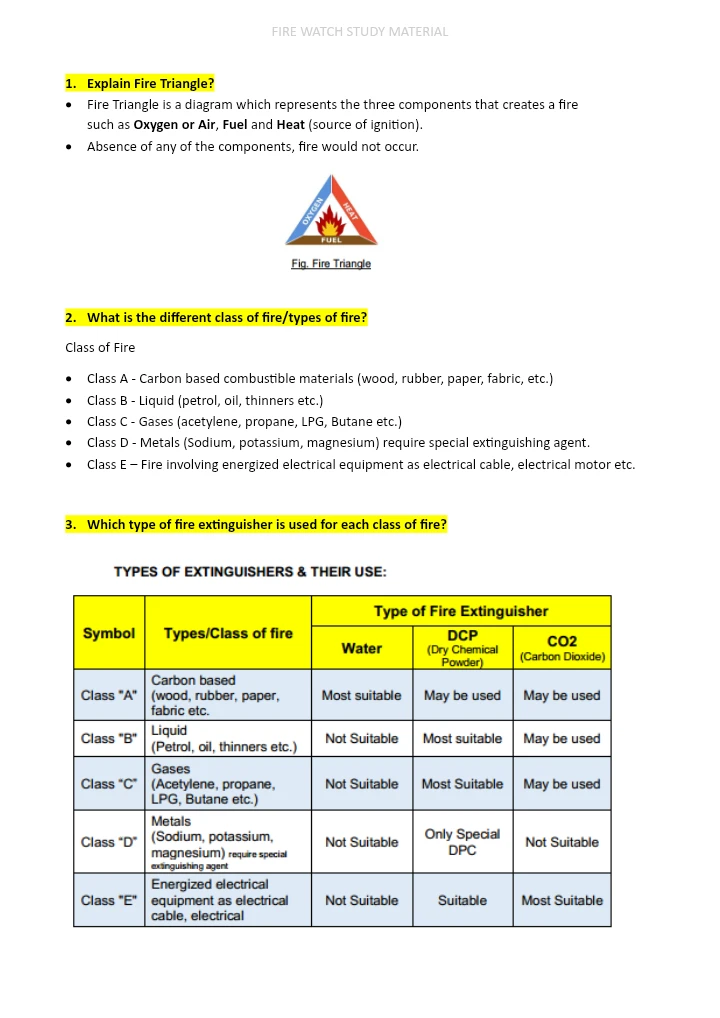
FIRE WATCH STUDY MATERIAL 1. Explain Fire Triangle? • Fire Triangle is a diagram which represents the three components that creates a fire such as Oxygen or Air , Fuel and Heat (source of ignition). • Absence of any of the components, fire would not occur. 2. What is the different class of fire/types of fire? Class of Fire • Class A - Carbon based combustible materials (wood, rubber, paper, fabric, etc.) • Class B - Liquid (petrol, oil, thinners etc.) • Class C - Gases (acetylene, propane, LPG, Butane etc.) • Class D - Metals (Sodium, potassium, magnesium) require special extinguishing agent. • Class E – Fire involving energized electrical equipment as electrical cable, electrical motor etc. 3. Which type of fire extinguisher is used for each class of fire?
FIRE WATCH STUDY MATERIAL 4. What is fire extinguishing principle? • Fire extinguishment principle involves elimination one or more of the components forming a Fire Triangle. Starving : The removal of fuel to the point so that nothing remains to burn. Example: turn off valves. Smothering : The removal of air or oxygen to point the so that combustion ceases. Example: fire blanket, foam and sand. Cooling : Cooling of fuel to the …
fire watch · fire watcher · fire safety · fire prevention · hot work · hot work permit · fire triangle · fire classes · class a fire · class b fire
Read FIRE WATCH STUDY MATERIAL online
- IS 15381:2021 – Fire Blanket — Specification (First Revision)
Indian Standard specifying material, construction, electrical resistance, fire performance, testing, workmanship, and marking requirements for non-reusable fire blankets intended…
- Types of Fire Sprinkler Systems – Wet Pipe, Dry Pipe, Pre-Action, Deluge and Specialised Systems
An 8-page illustrated fire protection guide explaining four main types of automatic sprinkler systems: wet-pipe, dry-pipe, pre-action and deluge. It also introduces foam-water, wa…
- A Few Important NFPA Codes and Standards – Fire & Life Safety
A quick-reference infographic covering important NFPA codes and standards used for fire protection, electrical safety, life safety, hot work, compressed gases and fire investigati…
- Handbook of Fire and Explosion Protection Engineering Principles for Oil, Gas, Chemical, and Related Facilities – Fourth Edition
A comprehensive engineering handbook covering fire and explosion prevention, protection and mitigation principles for oil, gas, chemical and related process facilities. It provide…
- REGISTER OF FIRE EXTINGUISHER – H-1
A practical fire extinguisher register format for recording the installation, inspection, maintenance, pressure testing, discharge and refilling history of fire extinguishers inst…
- Consultant’s Guide for Designing Fire Detection & Alarm Systems
A comprehensive 216-page consultant’s guide covering the planning, design, specification, installation, commissioning, maintenance and management of fire detection and alarm syste…
- IS 12407:1988 – Graphic Symbols for Fire Protection Plans
IS 12407:1988 specifies standardized graphic symbols for use on fire protection plans, architectural drawings, engineering layouts, and building safety documents. The standard pro…
- An Introduction to the NFPA Standards Development Process
This document provides a comprehensive overview of the National Fire Protection Association (NFPA) Standards Development Process. It explains how NFPA develops, revises, and publi…
