


Difference Between the Four Labour Codes of India is one of the most searched labour law topics for HR professionals, Safety Officers, Factory Managers, Employers, and Compliance Officers. This complete 2026 guide explains the differences, applicability, key features, compliance requirements, and implementation status of all four Labour Codes.
India’s labour law framework has undergone the most significant transformation since independence with the consolidation of 29 central labour laws into four comprehensive Labour Codes. For Safety Officers, HR Professionals, Factory Managers, EHS Professionals, Compliance Officers, Employers, and Labour Law Students, understanding these four Codes is no longer optional — it is a professional necessity. This guide, brought to you by THE EHS GURU, breaks down the Code on Wages, 2019, the Industrial Relations Code, 2020, the Code on Social Security, 2020, and the Occupational Safety, Health and Working Conditions Code, 2020, explaining exactly how they differ, overlap, and impact your day-to-day compliance responsibilities.
What are Labour Codes?
Labour Codes are consolidated pieces of legislation enacted by the Government of India that merge multiple existing labour laws dealing with a common subject matter into a single, unified statute. Instead of employers, HR teams, and compliance officers having to track dozens of separate Acts — each with its own definitions, applicability thresholds, registers, and penalty structures — a Labour Code brings related laws under one legislative umbrella with harmonised definitions and simplified procedures.
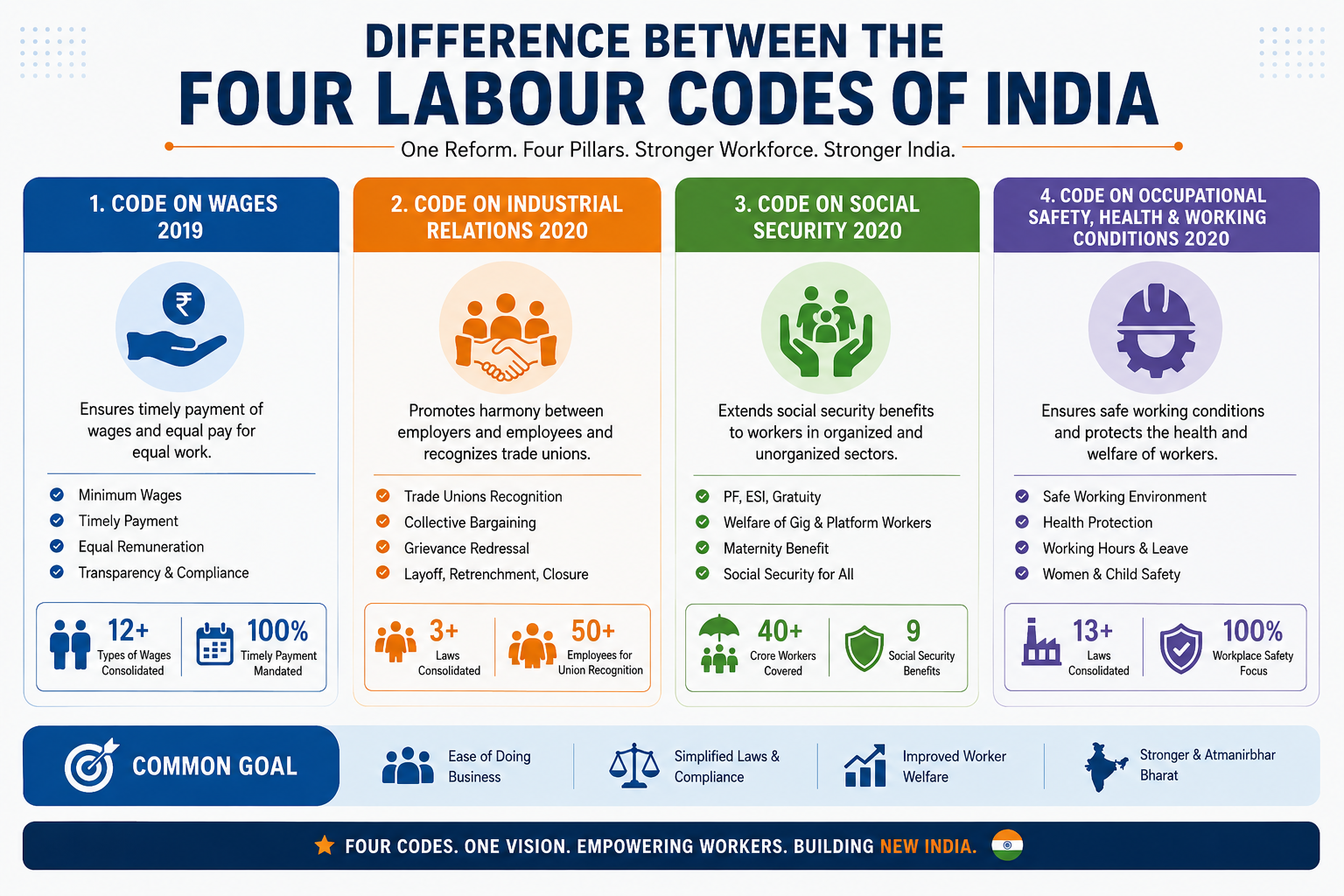
The Government of India has enacted four such Codes, which together replace 29 existing central labour laws:
- The Code on Wages, 2019
- The Industrial Relations Code, 2020
- The Code on Social Security, 2020
- The Occupational Safety, Health and Working Conditions Code, 2020
Why were the Labour Codes Introduced?
India’s labour law landscape had grown into a complex web of overlapping, and at times contradictory, statutes enacted over nearly a century. Different Acts used different definitions for the same terms (such as “wages,” “employee,” or “establishment”), different wage thresholds for coverage, and different compliance formats. This created several practical problems:
- Multiple registrations, licences, and returns for the same establishment under different laws.
- Inconsistent definitions leading to litigation and interpretational disputes.
- Poor coverage of workers in the unorganised and gig/platform economy.
- High compliance burden discouraging formalisation of employment and ease of doing business.
- Difficulty in enforcement due to fragmented inspection mechanisms.
The Second National Commission on Labour (2002) had recommended consolidating existing labour laws into broader groups to simplify compliance while strengthening worker protection. This recommendation formed the foundation for the four Labour Codes.
Objectives of Labour Law Reforms
The Ministry of Labour & Employment, Government of India, has outlined the following broad objectives behind the labour code reforms:
- Simplify and rationalise the multiplicity of labour laws into four broad Codes.
- Ensure universal minimum wage and timely payment of wages to all workers.
- Extend social security coverage to unorganised, gig, and platform workers.
- Strengthen occupational safety, health, and working condition standards across sectors.
- Promote ease of doing business through single registration, licensing, and returns.
- Provide a fair, transparent mechanism for industrial dispute resolution.
- Encourage the use of technology for inspections, compliance, and record-keeping.
- Balance the interests of employers and employees through a tripartite consultative process.
History of Labour Law Reforms in India
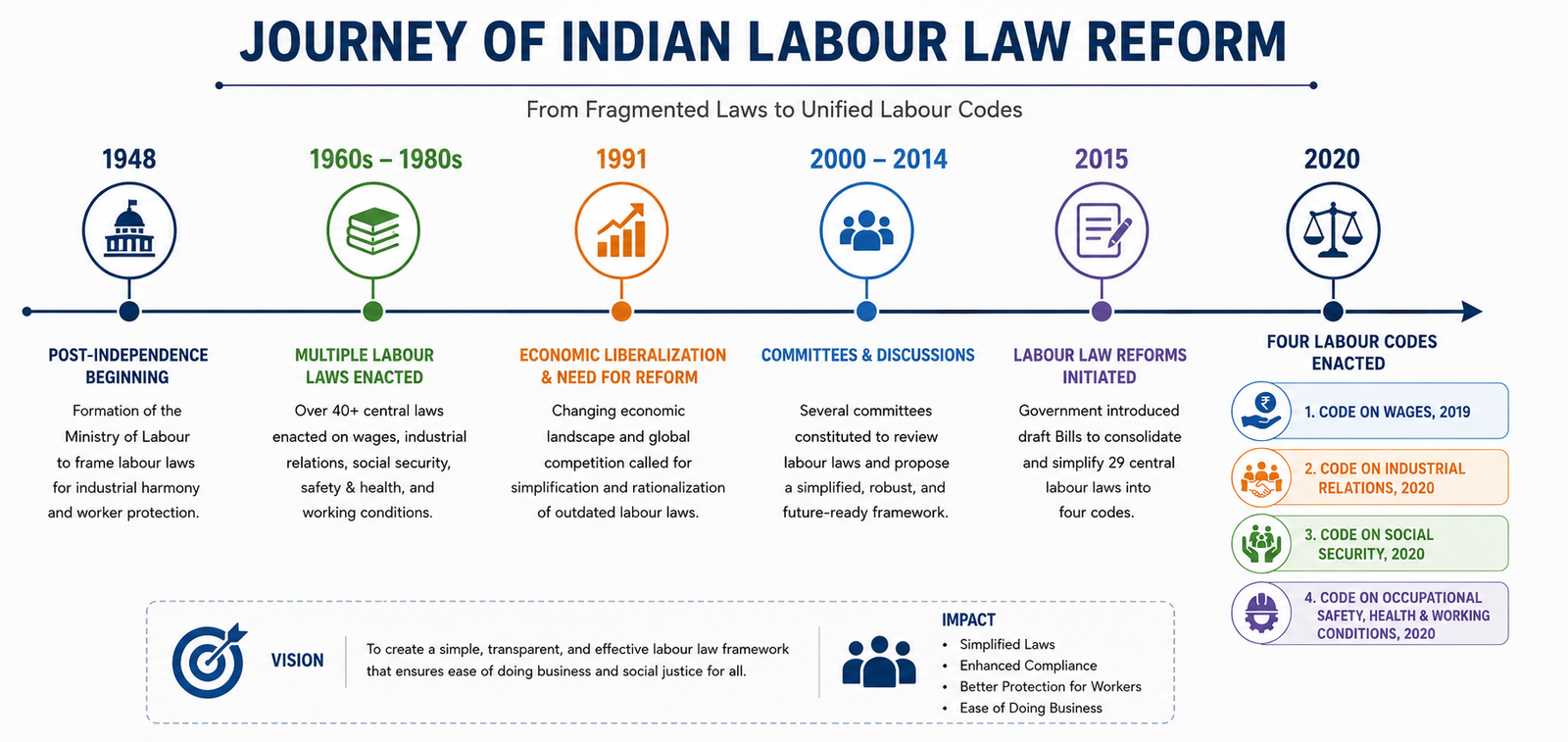
Labour law reform in India has been a decades-long process shaped by economic liberalisation, changing employment patterns, and demands from both industry and worker organisations. Key milestones include:
- 1929 onwards: Enactment of foundational labour laws such as the Trade Unions Act, 1926, and the Factories Act, 1948, during and after the colonial period.
- 1991: Economic liberalisation increases pressure to modernise labour regulation for global competitiveness.
- 2002: The Second National Commission on Labour recommends consolidation of central labour laws into broader groups.
- 2015 onwards: The Ministry of Labour & Employment initiates the process of drafting four Labour Codes through wide stakeholder consultations, including trade unions, employer associations, and state governments.
- 2019–2020: All four Codes are passed by Parliament and receive Presidential assent.
- 2020 onwards: Draft central rules are published for public comment; states begin framing corresponding state rules.
Timeline of the Four Labour Codes
| Labour Code | Introduced in Parliament | Passed by Parliament | Presidential Assent |
|---|---|---|---|
| Code on Wages, 2019 | 2019 | August 2019 | August 2019 |
| Industrial Relations Code, 2020 | 2020 | September 2020 | September 2020 |
| Code on Social Security, 2020 | 2020 | September 2020 | September 2020 |
| Occupational Safety, Health and Working Conditions Code, 2020 | 2020 | September 2020 | September 2020 |
Note: Exact dates should be verified against the official Gazette Notifications published by the Ministry of Law and Justice, Government of India, as notification dates for various sections and rules have been staggered across states.
The 29 Central Labour Laws Replaced by the Four Labour Codes
One of the most important things to understand is which older laws have been subsumed into which Code. This mapping is essential for compliance officers transitioning existing compliance calendars.
Laws Merged into the Code on Wages, 2019 (4 laws)
- The Payment of Wages Act, 1936
- The Minimum Wages Act, 1948
- The Payment of Bonus Act, 1965
- The Equal Remuneration Act, 1976
Laws Merged into the Industrial Relations Code, 2020 (3 laws)
- The Trade Unions Act, 1926
- The Industrial Employment (Standing Orders) Act, 1946
- The Industrial Disputes Act, 1947
Laws Merged into the Code on Social Security, 2020 (9 laws)
- The Employees’ Compensation Act, 1923
- The Employees’ State Insurance Act, 1948
- The Employees’ Provident Funds and Miscellaneous Provisions Act, 1952
- The Maternity Benefit Act, 1961
- The Payment of Gratuity Act, 1972
- The Cine Workers Welfare Fund Act, 1981
- The Building and Other Construction Workers’ Welfare Cess Act, 1996
- The Unorganised Workers’ Social Security Act, 2008
- The Employment Exchanges (Compulsory Notification of Vacancies) Act, 1959 (related provisions)
Laws Merged into the Occupational Safety, Health and Working Conditions Code, 2020 (13 laws)
- The Factories Act, 1948
- The Mines Act, 1952
- The Dock Workers (Safety, Health and Welfare) Act, 1986
- The Building and Other Construction Workers (Regulation of Employment and Conditions of Service) Act, 1996
- The Plantations Labour Act, 1951
- The Contract Labour (Regulation and Abolition) Act, 1970
- The Inter-State Migrant Workmen (Regulation of Employment and Conditions of Service) Act, 1979
- The Working Journalists and Other Newspaper Employees (Conditions of Service) and Miscellaneous Provisions Act, 1955
- The Working Journalists (Fixation of Rates of Wages) Act, 1958
- The Motor Transport Workers Act, 1961
- The Sales Promotion Employees (Conditions of Service) Act, 1976
- The Beedi and Cigar Workers (Conditions of Employment) Act, 1966
- The Cine Workers and Cinema Theatre Workers Act, 1981
Together, these four Codes replace a total of 29 separate central labour laws, some of which date back nearly a century, into a modern, harmonised compliance framework.
Overview of Each Labour Code
1. Code on Wages, 2019
The Code on Wages universalises the right to timely payment of wages and a statutory minimum wage to every worker in India, across both organised and unorganised sectors, regardless of wage ceiling. It merges four wage-related laws and introduces the concept of a “floor wage” to be set by the Central Government, below which no state can fix minimum wages.
2. Industrial Relations Code, 2020
This Code governs trade unions, employment conditions in industrial establishments through Standing Orders, and mechanisms for resolving industrial disputes, including retrenchment, layoff, and closure procedures. It introduces a “Negotiating Union” and “Negotiating Council” concept and revises the threshold for mandatory government permission before layoff/retrenchment/closure.
3. Code on Social Security, 2020
This is the broadest Code in terms of the number of laws merged (nine). It consolidates social security benefits — provident fund, pension, insurance, gratuity, maternity benefit, and employees’ compensation — and, for the first time, creates a specific legal framework for extending social security to gig workers, platform workers, and unorganised sector workers through a dedicated Social Security Fund.
4. Occupational Safety, Health and Working Conditions (OSH&WC) Code, 2020
This Code consolidates 13 laws relating to safety, health, and working conditions across factories, mines, docks, construction sites, plantations, and other establishments. It standardises provisions on working hours, leave, welfare facilities, appointment letters, and licensing of contractors, and lays down duties of employers towards occupational safety and health.
Key Features of Each Code
Key Features — Code on Wages, 2019
- Universal applicability of minimum wage and timely wage payment to all employees, irrespective of wage ceiling or sector.
- Introduction of a national “floor wage” fixed by the Central Government; state minimum wages cannot go below this floor.
- Uniform definition of “wages” across all four Codes, reducing litigation on wage components.
- Fixed wage periods — daily, weekly, fortnightly, or monthly.
- Provisions for payment of wages through bank transfer or digital modes.
- Statutory timelines for payment of bonus and resolution of wage-related disputes.
- Gender-neutral provision for equal remuneration for the same work or work of similar nature.
Key Features — Industrial Relations Code, 2020
- Mandatory Standing Orders now apply to establishments employing 300 or more workers (raised from 100), giving employers greater flexibility.
- Government permission for layoff, retrenchment, and closure required for establishments with 300 or more workers (raised from 100).
- Introduction of a “Negotiating Union” (a union with support of 51% or more workers) for collective bargaining.
- Fixed Term Employment formally recognised, with fixed-term employees entitled to the same benefits, wages, and working conditions as permanent employees.
- Re-skilling Fund to be created by employers for retrenched workers.
- Time-bound resolution mechanism for industrial disputes through Industrial Tribunals.
- Provisions for a two-member Industrial Tribunal in place of the earlier Labour Court/Tribunal structure.
Key Features — Code on Social Security, 2020
- Extension of Employees’ Provident Fund (EPF) and Employees’ State Insurance (ESI) coverage to a wider set of establishments and workers.
- Specific chapter for gig workers, platform workers, and unorganised workers, including a National Social Security Board.
- Aggregators (e-commerce, ride-hailing, food delivery platforms, etc.) required to contribute a percentage of their annual turnover towards the Social Security Fund for gig and platform workers.
- Maternity benefit provisions retained with 26 weeks of paid leave for eligible women employees.
- Gratuity extended to fixed-term employees on a pro-rata basis without the requirement of five years of continuous service.
- Provisions for Employees’ Compensation in cases of workplace injury, disability, or death.
- Enabling framework for portability of social security benefits, especially relevant for inter-state migrant workers.
Key Features — OSH&WC Code, 2020
- Mandatory appointment letter for every employee across covered establishments.
- Annual free health check-up for employees above a specified age, in establishments notified by the appropriate government.
- Enhanced threshold for factories requiring registration: 20 workers (with power) and 40 workers (without power).
- Single licence for contractors and single registration for establishments, valid across the lifetime of the establishment (subject to renewal norms as prescribed).
- Provisions for working hours, overtime, weekly holidays, and rest intervals standardised across sectors.
- Enhanced safety and welfare provisions for inter-state migrant workers, including a helpline and portability of benefits.
- Specific safety, health, and welfare provisions for factories, mines, dock work, construction work, plantations, and contract labour.
- Provision for a National Occupational Safety and Health Advisory Board and corresponding state boards.
Applicability of Each Code
Applicability under each Code differs based on the nature of the establishment, number of employees, and category of worker. The table below summarises typical applicability thresholds — actual thresholds notified may vary by state rules.
| Labour Code | General Applicability |
|---|---|
| Code on Wages, 2019 | Applies to every establishment, employer, and employee across organised and unorganised sectors; no wage ceiling for minimum wage and timely payment protections. |
| Industrial Relations Code, 2020 | Applies to industrial establishments; Standing Orders mandatory for establishments with 300+ workers; wider dispute resolution provisions apply broadly to industrial establishments. |
| Code on Social Security, 2020 | Applies to establishments covered under EPF, ESI, gratuity, and maternity benefit provisions based on notified employee thresholds; separate chapter applies to gig, platform, and unorganised workers regardless of establishment size. |
| OSH&WC Code, 2020 | Applies to factories (20+ workers with power, 40+ without power), mines, docks, plantations, construction sites, motor transport undertakings, and establishments employing contract labour (typically 50+ contract workers, subject to state notification). |
Coverage Under Each Code
| Labour Code | Who is Covered |
|---|---|
| Code on Wages, 2019 | All employees, including managerial, supervisory, and workmen categories, across organised and unorganised sectors. |
| Industrial Relations Code, 2020 | Workers in industrial establishments, including fixed-term employees; certain provisions exclude managerial/supervisory staff above a wage threshold from “worker” definition for dispute resolution purposes. |
| Code on Social Security, 2020 | Employees in covered establishments, unorganised workers, gig workers, platform workers, and inter-state migrant workers. |
| OSH&WC Code, 2020 | Workers in factories, mines, docks, plantations, construction sites, contract labour, and inter-state migrant workers; specific chapters for journalists, sales promotion employees, and audio-visual workers. |
Employer Responsibilities
Each Code places distinct obligations on employers. A consolidated view is essential for compliance planning.
| Labour Code | Key Employer Responsibilities |
|---|---|
| Code on Wages, 2019 | Pay at least the notified minimum/floor wage; pay wages within prescribed timelines; maintain wage registers; ensure equal remuneration; pay bonus where applicable. |
| Industrial Relations Code, 2020 | Issue Standing Orders where applicable; seek government permission before layoff/retrenchment/closure (where threshold applies); recognise Negotiating Union; contribute to re-skilling fund for retrenched workers. |
| Code on Social Security, 2020 | Register establishment under EPF/ESI as applicable; deposit employer and employee contributions timely; provide gratuity and maternity benefits; contribute to Social Security Fund if an aggregator. |
| OSH&WC Code, 2020 | Register establishment/factory; issue appointment letters; ensure safety, health, and welfare facilities; conduct risk assessments and safety audits; provide annual health check-ups; obtain contractor licences. |
Employee Rights and Benefits
| Labour Code | Key Employee Rights/Benefits |
|---|---|
| Code on Wages, 2019 | Right to timely payment of wages; right to minimum wage regardless of sector; right to equal pay for equal work; right to bonus where eligible. |
| Industrial Relations Code, 2020 | Right to form and join trade unions; right to collective bargaining through Negotiating Union/Council; protection against arbitrary retrenchment/closure; fixed-term employees entitled to parity in benefits with permanent employees. |
| Code on Social Security, 2020 | Right to provident fund, pension, and insurance benefits; right to gratuity (including pro-rata for fixed-term employees); right to 26 weeks maternity benefit; right to employees’ compensation for workplace injury; gig/platform workers’ right to social security coverage. |
| OSH&WC Code, 2020 | Right to a written appointment letter; right to safe and healthy working conditions; right to annual free health check-up; right to welfare facilities (canteen, crèche, restrooms); right to prescribed working hours and overtime wages. |
Compliance Requirements
The four Codes aim to simplify compliance through single registration, single licence, and single return mechanisms, replacing the multiple filings previously required under separate Acts.
- Single Registration: One registration for an establishment instead of multiple registrations under different laws.
- Single Licence: Contractors require a single licence valid across establishments and states (subject to prescribed conditions), instead of separate licences per Act/state.
- Single Return: Employers file one consolidated annual/periodic return instead of separate returns under each merged Act.
- Digital Compliance: Emphasis on electronic maintenance of registers, digital wage payment, and online filing of returns.
- Web-based Inspection System: Random computerised allocation of inspectors (referred to as “Inspector-cum-Facilitators”) to reduce discretion and improve transparency.
Registers and Returns
| Labour Code | Typical Registers/Records |
|---|---|
| Code on Wages, 2019 | Register of wages, register of deductions, register of fines, muster roll, wage slips. |
| Industrial Relations Code, 2020 | Register of Standing Orders, register of layoff/retrenchment/closure, records of union recognition and settlements. |
| Code on Social Security, 2020 | Register of employees for EPF/ESI, register of maternity benefit, register of gratuity payments, register of compensation claims. |
| OSH&WC Code, 2020 | Register of workers, register of appointment letters, register of health check-ups, register of accidents/dangerous occurrences, register of overtime, register of leave. |
Note: Exact formats of registers and returns are prescribed under the Central and State Rules notified for each Code and should be verified from the official Ministry of Labour & Employment portal.
Penalties Under the Four Codes
A notable reform across all four Codes is the enhancement of monetary penalties (as a deterrent) along with, in many cases, the option of compounding first-time minor offences instead of automatic imprisonment.
| Labour Code | Nature of Penalty Provisions |
|---|---|
| Code on Wages, 2019 | Fines ranging from a few thousand rupees to lakhs of rupees depending on the nature of violation (non-payment of minimum wage, non-payment of bonus, etc.); repeat offences attract imprisonment along with fine. |
| Industrial Relations Code, 2020 | Penalties for illegal strikes/lock-outs, unfair labour practices, and violation of Standing Orders; fines and imprisonment provisions for serious/repeat violations. |
| Code on Social Security, 2020 | Penalties for non-payment/delayed payment of EPF, ESI, gratuity, and maternity benefit contributions; enhanced fines with imprisonment for repeat default. |
| OSH&WC Code, 2020 | Penalties for violation of safety norms, failure to register establishment, non-issuance of appointment letters, and violations resulting in death/serious injury attract higher fines and imprisonment. |
Across all four Codes, the general principle is: first-time minor/procedural violations may be compounded on payment of a prescribed sum, while violations resulting in death or serious bodily injury attract stringent fines and imprisonment.
All Four Labour Codes at a Glance
| Aspect | Code on Wages, 2019 | Industrial Relations Code, 2020 | Code on Social Security, 2020 | OSH&WC Code, 2020 |
|---|---|---|---|---|
| Primary Focus | Wages and bonus | Trade unions, Standing Orders, disputes | Social security and welfare benefits | Safety, health, and working conditions |
| Number of Laws Merged | 4 | 3 | 9 | 13 |
| Key New Concept | Floor Wage | Negotiating Union | Social Security Fund for gig/platform workers | Single licence & registration |
| Main Regulator | Central/State Wage Advisory Boards | Industrial Tribunals, Labour Courts merged | EPFO, ESIC, Social Security Boards | National & State OSH Advisory Boards |
| Coverage Scope | Universal (all employees) | Industrial establishments/workers | Organised, unorganised, gig, and platform workers | Factories, mines, docks, construction, contract labour |
Important Differences Between All Four Codes
| Difference Point | Explanation |
|---|---|
| Subject Matter | Code on Wages deals purely with remuneration; IR Code deals with collective labour relations; Social Security Code deals with welfare benefits; OSH&WC Code deals with physical safety and working environment. |
| Applicability Threshold | Code on Wages has no wage ceiling and applies universally; IR Code’s key provisions (Standing Orders, retrenchment permission) apply at 300+ workers; OSH&WC Code applies at factory-specific worker thresholds (20/40); Social Security Code applicability varies by benefit type. |
| Regulatory Bodies Involved | Wage Code involves Wage Advisory Boards; IR Code involves Industrial Tribunals and Grievance Redressal Committees; Social Security Code involves EPFO/ESIC and new Social Security Boards; OSH&WC Code involves Factory Inspectorates and OSH Advisory Boards. |
| Worker Categories Covered | Wage Code covers every employee; IR Code distinguishes “workman” from managerial staff for dispute purposes; Social Security Code specifically includes gig/platform/unorganised workers; OSH&WC Code covers factory/mine/construction/contract workers specifically. |
| Nature of Compliance | Wage Code compliance is largely payment and record-based; IR Code compliance is procedural (union recognition, dispute notices); Social Security Code compliance is contribution-based; OSH&WC Code compliance is infrastructure and safety-system based. |
Benefits of the Four Labour Codes
- Simplified Compliance: Single registration, licence, and return reduce administrative burden for employers.
- Universal Wage Protection: Every worker, regardless of sector or wage level, is entitled to minimum wage and timely payment.
- Wider Social Security Net: First-ever statutory recognition and funding mechanism for gig and platform workers’ social security.
- Improved Ease of Doing Business: Reduced multiplicity of inspections and standardised definitions lower compliance costs.
- Stronger Safety Standards: Consolidated OSH provisions ensure consistent safety and welfare standards across previously fragmented sector-specific laws.
- Faster Dispute Resolution: Time-bound mechanisms for grievance redressal and industrial dispute settlement.
- Gender Parity: Uniform equal remuneration principle and continued maternity benefit protections.
- Formalisation of Workforce: Recognition of fixed-term employment with benefit parity encourages formal, benefit-backed employment.
Challenges in Implementation
- State Rules Pending/Staggered: Labour being a concurrent subject, both Central and State Governments must notify rules; differences in the pace of state-level notification have delayed uniform implementation.
- Transition Complexity: Employers must map existing compliance systems (registers, licences, contracts) to the new consolidated formats.
- Awareness Gap: Many small and medium establishments, and even some HR/EHS professionals, are not yet fully familiar with the changed thresholds and definitions.
- Trade Union Concerns: Some trade unions have raised concerns regarding the increased threshold (100 to 300 workers) for Standing Orders and retrenchment permission, arguing it could reduce job security for workers in mid-sized establishments.
- Technology Readiness: Digital registers, online returns, and web-based inspection systems require IT readiness across establishments, especially in rural or smaller units.
- Harmonising State Variations: Since states can notify their own rules within the Central framework, some variation in thresholds and procedures across states is expected, requiring multi-state employers to track state-specific rules.
Current Implementation Status
All four Labour Codes have received Presidential assent and been published in the Official Gazette. The Central Government has released draft/final Central Rules for each Code. However, since labour falls under the Concurrent List of the Indian Constitution, the Codes come into force only after both Central Rules and corresponding State Rules are notified and an appointed “coming into force” date is issued by way of a Gazette Notification. Employers and compliance professionals should always verify the current applicability status for their specific state(s) of operation on the official website of the Ministry of Labour & Employment (labour.gov.in) and their respective State Labour Department portals, as implementation dates have been updated periodically.
Practical Examples
Example 1: A Manufacturing Factory with 250 Workers
Under the OSH&WC Code, this factory (assuming it uses power) crosses the 20-worker threshold and must be registered as a factory, maintain safety registers, issue appointment letters, and conduct annual health check-ups. However, under the Industrial Relations Code, since it employs fewer than 300 workers, it is not mandatorily required to frame Standing Orders or seek government permission before retrenchment — though it must still follow due process such as notice and compensation.
Example 2: A Food Delivery Platform Engaging Gig Workers
Delivery partners engaged by an aggregator are not traditional “employees,” so they fall outside the Code on Wages and Industrial Relations Code in the conventional sense. However, under the Code on Social Security, 2020, the aggregator is required to contribute a percentage of its annual turnover to the Social Security Fund, extending welfare coverage such as accident insurance and health benefits to these gig workers.
Example 3: A Construction Site Employing Contract and Migrant Labour
The contractor must obtain a licence under the OSH&WC Code, ensure welfare facilities (drinking water, toilets, first aid) at the site, and register migrant workers to enable portability of benefits. Simultaneously, the principal employer must ensure timely wage payment under the Code on Wages and EPF/ESI compliance (where applicable) under the Code on Social Security for these workers.
Conclusion
The four Labour Codes of India — the Code on Wages, the Industrial Relations Code, the Code on Social Security, and the Occupational Safety, Health and Working Conditions Code — represent a landmark shift from a fragmented, century-old body of labour legislation to a modern, consolidated, and technology-enabled compliance framework. For Safety Officers, EHS Professionals, HR Managers, and Compliance Officers, the key takeaway is that each Code governs a distinct domain — pay, industrial relations, social security, and workplace safety respectively — yet they are designed to work together through harmonised definitions and simplified procedures. As states continue to notify their rules and the Codes progressively come into force, staying updated through official Ministry of Labour & Employment notifications will be essential for ensuring full and timely compliance.
Frequently Asked Questions (FAQs)
1. What are the four Labour Codes of India?
The four Labour Codes are the Code on Wages, 2019; the Industrial Relations Code, 2020; the Code on Social Security, 2020; and the Occupational Safety, Health and Working Conditions Code, 2020.
2. How many central labour laws have been replaced by the four Codes?
A total of 29 central labour laws have been consolidated into the four Labour Codes.
3. Which Code deals with minimum wages?
The Code on Wages, 2019, governs minimum wages, timely payment of wages, bonus, and equal remuneration.
4. What is the “floor wage” under the Code on Wages?
The floor wage is a base wage level fixed by the Central Government, below which no state government can set its minimum wage, ensuring a wage safety net across the country.
5. Which Code governs trade unions and industrial disputes?
The Industrial Relations Code, 2020, governs trade union registration, Standing Orders, and resolution of industrial disputes.
6. What is a Negotiating Union under the Industrial Relations Code?
A Negotiating Union is a registered trade union that has the support of at least 51% of workers in an establishment and is recognised for collective bargaining with the employer.
7. What is the new threshold for Standing Orders under the IR Code?
Standing Orders are now mandatory for industrial establishments employing 300 or more workers, an increase from the earlier threshold of 100 workers.
8. Which Code covers gig and platform workers?
The Code on Social Security, 2020, contains specific provisions recognising and extending social security coverage to gig workers and platform workers.
9. What is the Social Security Fund for gig and platform workers?
It is a dedicated fund to be built through contributions from aggregators (based on a percentage of annual turnover) and government support, used to provide social security benefits to gig and platform workers.
10. Which Code covers occupational safety and health provisions?
The Occupational Safety, Health and Working Conditions (OSH&WC) Code, 2020, covers occupational safety, health, and working conditions.
11. What is the factory registration threshold under the OSH&WC Code?
A factory using power requires registration if it employs 20 or more workers; a factory not using power requires registration at 40 or more workers.
12. Is an appointment letter mandatory under the new labour codes?
Yes, the OSH&WC Code mandates that every employer issue a formal appointment letter to each employee.
13. What is the maternity benefit entitlement under the new codes?
Eligible women employees are entitled to 26 weeks of paid maternity leave under the Code on Social Security, 2020, consistent with the earlier Maternity Benefit (Amendment) Act, 2017.
14. Are fixed-term employees eligible for gratuity?
Yes, under the Code on Social Security, fixed-term employees are entitled to gratuity on a pro-rata basis without needing to complete five years of continuous service.
15. What is the single registration concept under the labour codes?
Instead of registering separately under multiple laws, an establishment now obtains a single registration covering requirements across the applicable Code(s), reducing paperwork and duplication.
16. What is an Inspector-cum-Facilitator?
Under the new Codes, labour inspectors are re-designated as Inspector-cum-Facilitators, with random computerised allocation of inspections and an advisory role alongside enforcement.
17. Have the four Labour Codes come into force across India?
The Codes have received Presidential assent and been published in the Gazette; however, their actual enforcement date depends on notification of Central and State Rules, which has been staggered. Employers should verify current status through the Ministry of Labour & Employment.
18. Do the labour codes apply to the unorganised sector?
Yes, particularly the Code on Wages (minimum wage, timely payment) and the Code on Social Security (welfare schemes for unorganised workers) extend specific protections to the unorganised sector.
19. What happens to pending cases under the old labour laws?
The Codes typically contain repeal and savings clauses ensuring that pending proceedings, rights, and liabilities under the old laws continue to be governed by those laws until finally disposed of, even after the new Codes come into force.
20. What is the penalty for non-payment of minimum wages under the Code on Wages?
The Code on Wages prescribes monetary fines for non-payment of minimum wages, with enhanced fines and imprisonment for repeat offences; exact amounts should be verified from the notified Central Rules.
21. Which Code covers contract labour and inter-state migrant workers?
The OSH&WC Code, 2020, contains dedicated provisions for contract labour licensing and welfare, as well as registration and portability of benefits for inter-state migrant workers.
22. What is the significance of a uniform definition of “wages” across all four Codes?
A common, harmonised definition of “wages” reduces litigation and inconsistency that previously arose because different laws defined wages differently for computing benefits like PF, gratuity, and bonus.
23. Do the new labour codes reduce or increase employee benefits?
The Codes aim to expand coverage (e.g., to gig workers and fixed-term employees) while also giving employers more flexibility in certain areas (e.g., higher thresholds for Standing Orders); the net effect varies by establishment size and sector.
24. Who notifies the Rules under the four Labour Codes?
Both the Central Government (for central sphere establishments) and respective State Governments (for state sphere establishments) are empowered to frame and notify Rules under each Code.
25. Where can I find the official text of the four Labour Codes?
The official text of all four Codes, along with draft and final Rules, is published on the Ministry of Labour & Employment’s official website and the Gazette of India.
Related Article
Official References
- Ministry of Labour & Employment, Government of India — official website (labour.gov.in)
- The Code on Wages, 2019 — Gazette Notification, Ministry of Law and Justice
- The Industrial Relations Code, 2020 — Gazette Notification, Ministry of Law and Justice
- The Code on Social Security, 2020 — Gazette Notification, Ministry of Law and Justice
- The Occupational Safety, Health and Working Conditions Code, 2020 — Gazette Notification, Ministry of Law and Justice
- Report of the Second National Commission on Labour, 2002, Ministry of Labour & Employment
- Press Information Bureau (PIB), Government of India — releases on Labour Code reforms


Excellent and well-explained article! The comparison of all four Labour Codes is clear, informative, and easy to understand. It is a valuable resource for HR professionals, employers, employees, and students alike. Thank you for sharing such useful insights!