HAZOP Is Not the End – From Hazard Identification to Barrier Assurance and ALARP
PDF · 5 pages · English · Process Safety
A 5-page process safety insight explaining how HAZOP findings should progress into Bowtie analysis, LOPA, barrier assurance and ALARP decision-making. The document focuses on maintaining effective process safety barriers throughout the asset lifecycle.
By Reza Tahery Process Safety Perspective · Published 2026-10-03 · Updated 2026-11-14
From the document
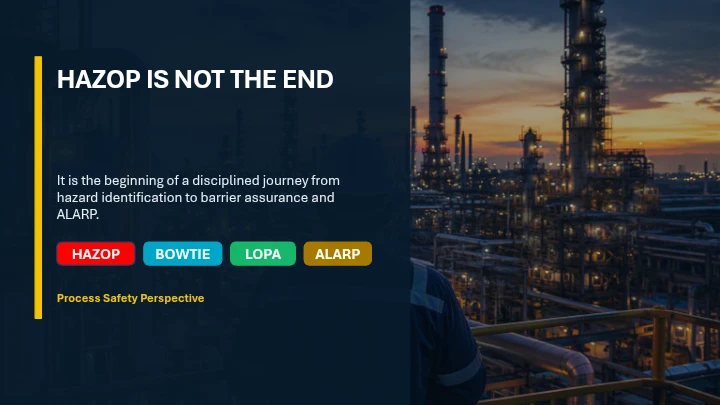
HAZOP IS NOT THE END It is the beginning of a disciplined journey from hazard identification to barrier assurance and ALARP. HAZOP BOWTIE LOPA ALARP Process Safety Perspective
P R O C E S S S A F E T Y | F R O M S T U D Y T O A S S U R A N C E R E Z A T A H E R Y 0 1 | I D E N T I F Y HAZOP reveals the scenarios A structured, multidisciplinary review challenges the design intent one deviation at a time. 1 Deviation What changes from the intended operating condition? 2 Cause What credible initiating event could create it? 3 Consequence What could happen if control is lost? 4 Safeguard What currently prevents or limits the outcome? KEY OUTPUT Clear, traceable hazard scenarios and recommendations. 2
P R O C E S S S A F E T Y | F R O M S T U D Y T O A S S U R A N C E R E Z A T A H E R Y 0 2 | V I S U A L I Z E Bowtie makes barrier logic visible Connect each credible threat to the top event, consequences, and the barriers that interrupt escalation. PREVENTION Keep threats from reaching the top event. TOP EVENT Define the exact moment control is lost. MITIGATION Reduce escalation and limit consequences. Ask: Is every claimed barrier valid? 3
P R O C E S S S A F E T Y | F R O M S T U D Y …
hazop · hazard and operability study · process safety · process safety management · bowtie analysis · bowtie · lopa · layer of protection analysis · alarp · barrier management
Read HAZOP Is Not the End – From Hazard Identification to Barrier Assurance and ALARP online
- Process Safety Management - 20 Elements Clause-wise Training Module
Clause-wise theoretical training on the 20 PSM elements: OSHA 29 CFR 1910.119 elements 1-14 (each with regulatory text, interpretation, key requirements, principles and terminolog…
- Process Safety – Part 4: Risk Matrix, Risk Assessment and Risk Reduction
A 10-page illustrated learning resource explaining how risk matrices combine likelihood and consequence to rank process safety scenarios, evaluate residual risk, and identify when…
- IEC 61882:2016 – Hazard and Operability Studies (HAZOP Studies): Application Guide
IEC 61882:2016 provides guidance on conducting Hazard and Operability (HAZOP) studies using guide words to systematically identify deviations from design intent, examine their cau…
- Golden Rules of Process Safety for Nitrogen (N₂) – GR5
A process safety guideline covering five Golden Rules for managing hazards associated with nitrogen (N₂), including hazardous properties, equipment identification, prevention and…
- CCPS Monograph: Addressing High Consequence, Low Probability Risk Scenarios within a Risk Based Process Safety Framework
CCPS monograph addressing High Consequence, Low Probability (HCLP) risk scenarios within a Risk Based Process Safety framework. It examines the technical and cultural challenges a…
- Furnace Explosion and Fire at Shell Polymers – Investigation Report
A 70-page U.S. Chemical Safety and Hazard Investigation Board (CSB) investigation report on the June 4, 2025 furnace explosion and fire at Shell Polymers in Monaca, Pennsylvania.…
- Process Hazard Analysis (PHA) – Hazard Identification, Risk Assessment, What-If Analysis and HAZOP
A 103-slide training presentation on Process Hazard Analysis (PHA), covering hazard identification, risk concepts, experience-based and predictive assessment methods, What-If Anal…
- Hazardex – October 2026 Edition | Journal for Hazardous Area Environments
October 2026 edition of Hazardex, a journal covering process safety, hazardous-area environments, petrochemical safety, explosion protection, automation, robotics, alarms and indu…
